Merab Abramishvili “Transparent Memory”
The main themes of Merab Abramishvili’s work center on the concept of life’s eternity, expressed through a religious model of perceiving the universe, shaped by personal perspective and defined by the historical events of the period in which he lived.
The concept of life governs all the motifs in his work, encompassing both its mundane and otherworldly dimensions: the model of the universe, the iconography of images, and the unity of details. In the artist’s paintings, everything connects to the reservoir of life, conveying a narrative of the regularities, transformations, vibrations, and impulses that arise from it and shape its many interpretations.
Merab Abramishvili’s work embodies a range of aesthetic and artistic influences, including a dominant, translucent documentation of the universe. He presents a structural model of the world, where the image extends beyond the boundaries of visible reality and acquires the phantasmagoric hue of an invisible realm—sometimes serving as a symbol, and at other times functioning as a cultural code.
The artist worked within the boundaries and aesthetic climate shaped by the inertia of medieval Georgian painting, the weight of tradition, the synthesis of Western and Eastern cultures, and the cultural codes of the global art scene. His work reflects the patterns and experiences of world culture, while his style offers interpretations informed by these influences.
Merab Abramishvili is a representative of the “eighties generation” who, at the end of the 20th century, elevated Georgian art to a new level within postmodernist culture.
The tragic violence that marks the modern world, and which took on a horrendous form in 1980s Georgia, fostered among the artists of his generation a need to escape from reality and a desire to create their own, personal utopias. In Abramishvili’s work, this personal utopia manifested as an expression of the world’s beauty, the supremacy of eternity, and a religious context.
The artist dematerializes matter and reduces everything he deals with to a transparent substance that oozes on the verge of presence and absence, reinforcing this impression through the manifestation of fragility, disappearance, and transformation. Like examples from medieval art, the bodies in his figurative images become so weightless that their movements create the impression of flight: people, plants, and animals appear to be connected through dance. The rhythm of color and line produces emotional impulses. “A dream that is sketched through the denial of objects” (Galaktion Tabidze) expresses the superiority of a spiritual register where the symbols are associated with the context, at times transforming it into a sign. This is particularly characteristic of religious narratives, where Merab Abramishvili returns to themes that had been banned from Georgian painting for fifty years due to the ideology of socialist realism. He achieves this through the application of new forms that lead back to our roots. With the introduction of a model of seeds and roots, the artist creates an iconographic scheme of plants, which becomes an essential component of the overall structure. Around it, he “weaves” a network of leaves, stems, and flowers. Sometimes he transforms the flowers into seeds, captures the plants in their transitional life cycles, and reveals them during the fragile phases of blossoming and fruit development.
The conditional world of Abramishvili’s paintings is constructed from archetypal indices: heaven, hell, the Garden of Eden, biblical cities, rivers, and characters. Together, these elements form a unified cosmogonic system, in which every detail is a component of the universe, contributing to its essence and context. Merab Abramishvili is a painter of the cosmos. He depicts an image of the universe that captures both its integrity and diversity, conveying it with a sense of transparency through the interplay of its constituent parts. This creates a continuous visual process, where each element participates in a common flow that moves from painting to painting and encompasses his entire body of work. The horizontal friezes and vertical panels of the paintings serve as specific formats animated by rhythmic lines, floating weightless figures, embroidery-like plants, ornamented fabrics, glowing seeds of blackberry and rosehip, sun motifs resembling sunflowers, the uneven skin of a panther, and landscapes transformed into arabesques. These compositions resemble multi-layered palimpsests composed of luminous spots and filigree etchings. They evoke memories of dreams which, upon waking, dissolve from sight and thought, leaving behind only transparent traces.
Abramishvili’s works conjure the impression of traversing a realm of living substance: we find ourselves in the Garden of Eden, walking through groves of olive and pomegranate trees, wandering among rows of rosehips, sunflowers, ferns, and palms, and becoming entangled in a jungle of roots and branches. We journey through a fantastical environment, accompanied by birds of paradise, peacocks, deer, and leopards. Through a kind of seductive magic, the artist introduces us to this strange world—one that feels eerily familiar, as if we have visited it once before. These are dreams, futuristic visions, labyrinths of memory… This is the universe, a place where all creations are sacrosanct, their existence determined by a single value system rather than a hierarchy. Here, life triumphs over death, transforming the setting into the abode of fairy tales, myths, ancient legends, and bygone heroes. The repeated mantra of these sensations is affirmed in every work: I was here, and I will return.
The importance of tradition is evident in his choice of artistic style and technique. Abramishvili often addresses themes, images, and stylistic elements scattered throughout culture, ranging from cave paintings and antiquity to the Middle Ages, Renaissance, modern, and avant-garde periods. “Ateni Sioni,” dancers, “Shavlego,” “Thevdore” – these are the artist’s references to Georgian themes. However, in terms of cultural context, Merab Abramishvili is an artist of global thought and broad vision.
The artist introduces cultural elements in a metaphorical, metanarrative fashion. He rarely presents them as merely external images or accessories, but spreads the power of tradition like the impulse in a genetic code. The expressive dynamics of Georgian dance are manifested not only in the dancers wearing Georgian costumes, but also in the bodily grace of all his characters, in the plasticity of plants, in the outlines of details, and in the rhythmic pyrotechnics of their arrangement. By utilizing the expressive potential of line, the artist creates the impression of dance everywhere. The polyphony of Georgian religious hymns is echoed in the polystructurality of his paintings. Achieving harmonious unity through the integration of diverse elements is a complex task. The most intricate combinations of details united in the shared formats of his compositions create a rich spectrum of visualization, and evoke the effect of a kaleidoscope infused with the magic of transformation.
The importance of cultural origins and roots are directly reflected in the images of plants. The artist depicts their structure—including leaves, branches, fruits, and roots—constructing them as heraldic objects. He shows them on both levels: above and beneath the earth. In Abramishvili’s paintings, plants are part of the universe—a symbol of life, a vital artery in the underworld and the afterlife. Through the iconography of plants, the artist expresses the eternal dilemma of attachment and freedom, the importance of tradition and detachment from it.
Merab Abramishvili’s technique is also a continuation of this idea. It represents a successful attempt to transform one of the oldest painting methods into a modern experience, allowing his works to reveal a unique textural expressiveness. Applying tempera on a board covered with gypsum—the Levkas technique—offers a synthesis of medieval monumental fresco painting and iconography: a revival of tradition and the introduction of an innovative opus at the same time. The pictorial format and color palette are shaped by the texture of the background, multilayered colors, and the technique of washing out the paint. The use of thin brushes to apply contours and countless details defines Abramishvili’s distinctive style and establishes an entire mood in which the finest, most delicate details dominate the composition with striking artistry. The paintings are dense, but never overloaded. On the contrary, they build into a harmonious whole, in which the artist approaches the creative process with the precision and boundless patience of a calligrapher.
Equipped with the skills of a perfectionist, the artist not only transforms standard themes and models of beauty—such as paradise, gardens, people, animals, and plants—into aesthetic values and manifestations of celebration, but also incorporates images of death, war, hell, crucifixion, mourning, and Judgment Day. In his works, even death is presented as a beautiful and grand phenomenon. Coming to terms with death and acknowledging its greatness, along with the continuation of life in another form, can be seen in the works “Shavlego,” “Thevdore,” “Harakiri”, “The Last Judgment,” and “The Crucifixion.” These works all remind viewers of the notion of “suppressing death with death itself.”
In Merab Abramishvili’s works, dynamics and expression are always anchored in the drawing, and reinforced by color, outlined with contour, and revealed through the rhythm of movement and the expressiveness of gesture. The lines are executed masterfully, transforming the drawing into a virtuoso artwork. The body language is eloquent—extremely graceful, fluid, and rhythmic—and often resembles flight or dance.
The universe is always beautiful in the artist’s work. Each painting, in its own way, affirms that the world’s resources are inexhaustibly diverse, and that the interpretation of events knows no bounds. This is the hallmark of masters who engage with issues of cosmic scale and express their perspectives on religion and humanism—artists whose creative memory, like ancient manuscripts, holds countless cultural layers and translucent outlines. Abramishvili created a completely new model of painting that emerged in the late 1980s in Georgia, a country located on the geographic border between West and East, at a time when one order—the Soviet Union—was collapsing and a new one had yet to take shape.
In Georgia of the 1990s, the oft-repeated phrase “The war is over, fear peace, people!” from Bertolt Brecht’s “The Caucasian Chalk Circle”—which has been playing to full houses at the Shota Rustaveli Theater since 1975—took on the weight of a strange prophecy. In 1992, the end of the war brought no relief, only a different kind of hardship, and it was neither the time nor the place for art. For many years, all of us who lived through that period and environment faced a daily test of physical survival. Art was banished from people’s lives and minds just as Adam and Eve were expelled from Paradise. Abramishvili’s devotion to painting became a form of heroism and sacrifice, while also offering a means of survival.
These were difficult, cruel, and terrifying times for Georgia. In Tbilisi, on Shota Rustaveli Avenue, the first protests demanding Georgia’s independence were held near the Parliament building, in front of the exhibition center known as the Artist’s House, where Abramishvili’s studio was located. These demonstrations were followed by the civil war of 1991-1992 and the war in Abkhazia. The unrest also affected the artist personally: his studio and works were burned down, while his painting “Hell” came to resemble Georgia, which at the time was engulfed in flames. None of the works depict reality directly, but all of them carry the emotional imprint of those events. They convey a sense of emotional dualism and persistent misfortune that alludes to a longing for happiness and peaceful existence—a sentiment shared by many artists of his generation. Against the backdrop of these events, Abramishvili’s work offered a deeply personal reflection on the existential questions at the heart of human life. The uglier the reality became, the more idealized the world he created. The more horrific the events, the more insistently he turned our attention to humanistic values. And yet, even in his most dramatic works, it is life that ultimately triumphs—its continuation, its impulses.
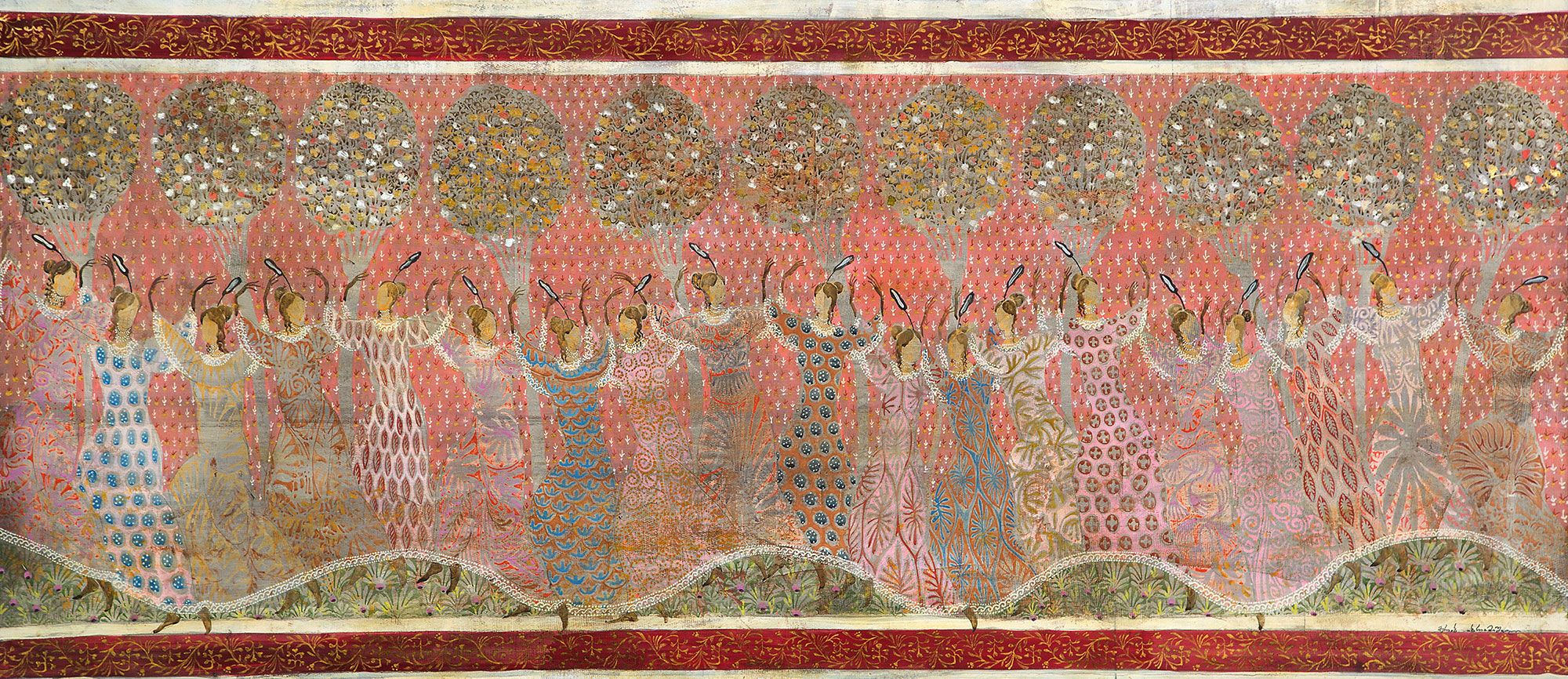
That is why, during this very period, Merab Abramishvili created beautiful gardens of paradise filled with translucent flowers and colorful trees, where deer and peacocks roamed among them; “images” of various figures—including people, animals, and plants; Silk Road compositions in the form of arabesque-like painted friezes adorned with silhouettes of dancing women dressed in vibrant silk gowns with ornamental patterns; as well as a range of religious themes and characters. At the same time, the artist painted scenes of hell filled with rivers of blood or infernal flames; the monumental epic saga of “Apocalypse;” multiple versions of “Judgment Day;” and the phantoms of war in the compositions “Three Hundred Aragvians” and “Sacrificed.” The tragedy of death is expressed in works such as “The Crucifixion,” “Shavlego,” “A Wounded Bison,” “Thevdore,” and “Harakiri.” Meanwhile, compositions including “Entry into Jerusalem,” “Mourning,” “Paradise,” and “Feast of the Cross” focus on the expectation of the resurrection and the celebration of life.
In the 1990s, Eduard Shevardnadze made a complex strategic move through the Tbilisi-Baku-Ceyhan project, aiming to restore Georgia’s geopolitical significance and reintroduce the notion of the Silk Road into political and economic discourse, as well as into the consciousness of the Georgian people. Despite the promise of peace, the project was fraught with risk: reviving the Silk Road on Georgian territory carried real danger, as the route was strewn with landmines, and navigating it required extreme caution. Abramishvili transformed the adrenaline born of danger into a vision of beauty. In his “Silk Road” compositions, female figures dressed in colorfully painted garments are depicted in the orans pose, hands raised to the sky, evoking characters more engaged in ritual prayer than in entertainment. “Silk Road” becomes both a dance on a minefield and a posture of supplication, combining multiple elements into a single, expressive narrative. What can defuse danger on an emotional level? The artist’s answer lies in beauty: a utopian ideal imbued with a sense of loss. The horizontal friezes of the “Silk Road” series, with their calligraphy-like ornamentation, were inspired by Pompeian and Etruscan art. At the same time, they are saturated with modern ornamental stylization and reflect the refined character of wall painting – an echo of the epochs and aesthetic traditions once brought to Georgia along the ancient Silk Road.
The artist’s works open up the universe with its polar regularities, grandeur, and power—forces that operate with the finesse of both microcosm and macrocosm. He reveals the invisible and visible connections among all the world’s creations and, through a process of fetishization, elevates them to the status of icons.
Merab Abramishvili’s work contains ubiquitous, translucent references; expresses regret over the loss and destruction of beauty; demonstrates a delicate concern for existence; and celebrates both the wonder of the universe and the sanctity of life.
Baia Tsikoridze
გამჭვირვალე მეხსიერება
მერაბ აბრამიშვილის შემოქმედების მთავარი თემა სიცოცხლის მარადიულობის პრეზენტაციაა, გამოხატული სამყაროს შეცნობის რელიგიური მოდელით, განვრცობილი პერსონალური მოდიფიკაციით და იმ პერიოდის მოვლენებით განპირებებული, რომელშიც მხატვარს მოუწია ცხოვრება.
სიცოცხლის ცნება, ამქვეყნიურ და იმქვეყნიურ განზომილებაში, განსაზღვრავს მისი მხატვრობის ყველა მოტივს – სამყაროს მოდელს, ქმნილებათა იკონოგრაფიას, დეტალების კომპლექტაციას. მის შემოქმედებაში ყველაფერი სიცოცხლის რეზერვუართან კავშირს გამოხატავს და იმ კანონზომიერების, გარდასახვების, ვიბრაციის და იმპულსების შესახებ გვიყვება, რომლებიც სიცოცხლის ცნებასთან და მის ინტერპრეტაციებთან არის დაკავშირებული.
მერაბ აბრამიშვილის მხატვრობა ესთეტიკური და მხატვრული ზემოქმედების რამდენიმე პოზიციით მოქმედებს და მათ შორის სამყაროს გამჭვირვალე ფიქსაციაა დომინანტური. მხატვარი სამყაროს მოწყობის ისეთ მოდელს გვთავაზობს, როცა გამოსახულება ხილული რეალობის საზღვრებს ტოვებს და უხილავი სამყაროს ფანტასმაგორიულ ელფერს იძენს, ზოგჯერ სიმბოლოს მნიშვნელობით მოქმედებს, ზოგჯერ კი კულტურის რომელიმე კოდის სახით ფიქსირდება.
შუა საუკუნეების ქართული მხატვრობის ინერცია და ტრადიციის მნიშვნელობა, დასავლურ-აღმოსავლურ კულტურათა სინთეზი, მსოფლიო ხელოვნების კოდები – ის ესთეტიკური კლიმატია, რომლის საზღვრებშიც მოქმედებს მხატვარი. მისი შემოქმედება მსოფლიო კულტურის ნიმუშებს და გამოცდილებას ირეკლავს, მისი სტილი კი – ამ გამოცდილებით მიღწეული ინტერპრეტაციებია.
მერაბ აბრამიშვილი „ოთხმოციანელთა“ თაობის წარმომადგენელია. ამ თაობამ XX საუკუნის ბოლოს ახალ ფაზაში – პოსტმოდერნის კულტურაში გადაიყვანა ქართული ხელოვნება.
თანამედროვე სამყაროსთვის დამახასიათებელი ტრაგიკული ძალმომრეობა, რომელმაც საქართველოში შემზარავი სახე მიიღო XX საუკუნის 80 – იანი წლების ბოლოს, ოთხმოციანელთა თაობის მხატვრებში რეალობიდან თავის დაღწევის აუცილებლობას და პერსონალური უტოპიის შექმნის სურვილს იწვევდა. ეს პერსონალური უტოპია მერაბ აბრამიშვილის შემოქმედებაში სამყაროს სილამაზის სტატუსით, მარადიულობის უპირატესობის დემონსტრირებით და რელიგიური კონტექსტით არის გადმოცემული.
მხატვარი მატერიის დემატერიალიზაციას ახდენს, გამჭვირვალე სუბსტანციამდე მიჰყავს ყველაფერი, რასაც ეხება, ყოფნა – არყოფნის ზღვარზე მოიაზრებს; სიმყიფის, გაქრობის, გაუჩინარების, გარდასახვის ილუზიამდე აძლიერებს ამ შთაბეჭდილებას. შუა საუკუნეების ხელოვნების მსგავსად, მისი ფიგურატიული გამოსახულებების სხეულებრიობა იმდენად უწონოა, რომ მოძრაობით ფრენის შთაბეჭდილება იქმნება, ადამიანების, მცენარეების და ცხოველების პლასტიკით კი – ცეკვის; ფერის და ხაზის რიტმით ემოციური იმპულსები ჩნდება. „ოცნება ნახაზი საგანთა უარით” (გალაკტიონ ტაბიძე) – სულიერების რეგისტრის უპირატესობაზე მიუთითებს. სიმბოლოები ყოველთვის კონტექსტის მინიშნებაა და ზოგჯერ კონტექსტი გარდაიქმნება სიმბოლოდ, განსაკუთრებით რელიგიურ სიუჟეტებში. მერაბ აბრამიშვილი რელიგიურ მხატვრობას, სოციალისტური რეალიზმის იდეოლოგიის გამო ორმოცდაათი წლის განმავლობაში განდევნილს ქართული მხატვრობიდან, უკან აბრუნებს ახალი ფორმით – ეს ის მარცვალია, რომელსაც ფესვებთან მივყავართ. მარცვლების და ფესვების მოდელით აგებს მხატვარი მცენარეების იკონოგრაფიულ სქემას, აუცილებელ კომპონენტად მოიაზრებს მათ საერთო სტრუქტურაში, მათ გარშემო „ქსოვს“ ფოთლების, ღეროების და ყვავილების ქსელს. ზოგჯერ ყვავილებს გარდაქმნის მარცვლებად, მცენარეს სიცოცხლის შუალედურ ეტაპებში აფიქსირებს, აყვავების და ნაყოფად ქცევის მთრთოლარე ფაზებში გვიჩვენებს მცენარეს.
სურათების პირობითი გარემო შედგენილია არქეტიპული ინდექსებით – სამოთხე, ჯოჯოხეთი, ბაღი, ბიბლიური ქალაქები, მდინარეები, პერსონაჟები და ეს ყველაფერი ერთიან კოსმოგონიურ სისტემას ქმნის, სადაც თითოეული კომპონენტი, დეტალი მთლიანი სამყაროს ნაწილია, ამ სამყაროს არსს და კონტექსტს მოიცავს. მერაბ აბრამიშვილი კოსმოსის მხატვარია, სამყაროს ხატ – სახეს გამოსახავს, მის მთლიანობას და მრავალფეროვნებას განიცდის და მას გამჭვირვალობის ეფექტით გადმოსცემს, რაც მისი შემადგენელი კომპონენტების ერთმანეთზე ზემოქმედების შედეგზეა გათვლილი, როცა ყველა დეტალი საერთო ნაკადში მონაწილეობს და ეს გამჭვირვალე ნაკადი ერთი ნახატიდან მეორეში გადადის და მის ყველა ნამუშევარს მოიცავს. ნახატების ჰორიზონტალური ფრიზები და ვერტიკალური ფირფიტები სპეციფიკური ფორმატებია, შევსებული რიტმული ნახაზით, უწონადი, მოფარფატე ფიგურებით, ნაქარგის მსგავსი მცენარეებით, ორნამენტით მორთული ქსოვილებით, ასკილის და მაყვლის მოციმციმე მარცვლებით და მზესავით მზესუმზირებით, ავაზის ხაოიანი კანით, არაბესკებად ქცეული ლანდშაფტებით. ნამუშევრები თითქოს მრავალშრიანი პალიმფსესტებია, შექმნილი ფერადი ლაქებითა და ფილიგრანული ნახატით. სიზმრის მეხსიერებაა, როცა გაღვიძებისას თვალებიდან და გონებიდან გაგირბის ნანახი და მხოლოდ გამჭვირვალე ანაბეჭდად რჩება.
ისეთი შთაბეჭდილებაა, თითქოს ცოცხალი სუბსტანციის ზონაში ვმოძრაობთ – სამოთხის ბაღში ვიმყოფებით; ზეთისხილის, ბროწეულის ტყეებში მივაბიჯებთ; ასკილის, მზესუმზირას, გვიმრების, პალმების ტევრში ვტრიალებთ; ფესვების და ტოტების აბლაბუდაში ვართ გაბმული. ფანტასტიკურ გარემოში ვმოგზაურობთ სამოთხის ჩიტების, ფარშევანგების, ირმების და ავაზების თანხლებით. მხატვარს მაცდუნებელი ჯადოქრობით შევყავართ ამ უცნაურ სამყაროში, სადაც თითქოს ოდესღაც ნამყოფი ვართ – სიზმრებში, ფუტურისტულ ოცნებებში, მეხსიერების ლაბირინთებში… ეს ის სამყარო და ადგილია, სადაც ყველა ქმნილება დაცულია, მათი არსებობა ფასეულობის ერთი მოდელით განისაზღვრება და არა იერარქიული სისტემით. აქ სიცოცხლე სიკვდილს ამარცხებს და ეს ადგილი ზღაპრების, მითების, უძველესი ამბების, საგმირო ისტორიების და ისტორიული გმირების სამყოფელია. მე აქ ვიყავი და აქ დავბრუნდები – ამ შეგრძნებების მანტრა ტრიალებს, ამ განცდის აფირმაციაა ყველა ნამუშევარში.
ტრადიციის მნიშვნელობა მხატვრული სტილის და ტექნიკის არჩევანში ვლინდება. მხატვარი ხშირად მიმართავს კულტურის წიაღში გაფანტულ თემებს, გამოსახულებებს, სტილისტურ მიგნებებს – გამოქვაბულის მხატვრობიდან და ანტიკური ხანიდან დაწყებული, შუა საუკუნეების და რენესანსული კულტურის გავლით – მოდერნის და ავანგარდის ეპოქამდე. ატენის სიონი, მოცეკვავეები, შავლეგო, თევდორე – ასეთია ქართულ თემატიკასთან მისი შეხება, მაგრამ კულტურის კონტექსტური მიმართვების მასშტაბით ის გლობალური აზროვნების არტისტი და ფართოდ მხედველი შემოქმედია.
კულტურის ნიშნები მხატვარს მეტაფორულად, მეტანარატივად შემოაქვს, და იშვიათად გადმოაქვს მხოლოდ გარეგნული სახით ან აქსესუარით. ტრადიციის ძალა გენეტიკური კოდის იმპულსივით ვრცელდება სტილის ნახაზში. ქართული ცეკვის ექსპრესიული დინამიკა არა მხოლოდ ქართულ ტანისამოსში გამოწყობილ მის „მოცეკვავეებში“ ვლინდება, არამედ ყველა პერსონაჟის სხეულებრივ გრაციოზულობაშიც, მცენარეების პლასტიკაში, დეტალების მოხაზულობებში და მათი განლაგების რიტმულ ფეიერვერკში – მხატვარი ხაზის ექსპრესიით ყველგან ცეკვის შთაბეჭდილებას ქმნის. ქართული საგალობლების პოლიფონიურობა მისი მხატვრობის პოლისტრუქტურულობით არის გამოვლენილი. რთული ამოცანაა – განსხვავებულთა ერთიანობით ჰარმონიულ მთლიანობას მიაღწიო. დეტალების ურთულესი კომბინაციები, გაერთიანებული კომპოზიციების საერთო ფორმატებში, ვიზუალიზაციის რთულ სპექტრს ქმნის და გარდასახვის ჯადოსნურობით კალეიდოსკოპის ეფექტს გვახსენებს.
კულტურის საწყისების და, საერთოდ, ფესვების მნიშვნელობა პირდაპირი მინიშნებითაა აღბეჭდილი მცენარეების გამოსახულებაში. მხატვარი მცენარის სტრუქტურას, ფოთლებით, ტოტებით და ნაყოფებით დატვირთულს, ფესვებიანად გამოსახავს, ჰერალდიკური ობიექტის სახით აგებს, ერთდროულად მიწის წიაღშიც გვიჩვენებს მას და მიწისგან განცალკევებულადაც წარმოგვიდგენს. მცენარე მის ნახატებში სამყაროს ნაწილიც არის, სიცოცხლის სიმბოლოც და ქვესკნელ-ზესკნელის სასიცოცხლო არტერიადაც წარმოგვიდგება; მცენარის ამ იკონოგრაფიით მიჯაჭვულობის და თავისუფლების მარადიულ დილემას გამოხატავს, ტრადიციის მნიშვნელობას და მისგან დისტანცირების იდეას მიჰყვება.
მერაბ აბრამიშვილის ტექნიკაც ამ იდეის გაგრძელებაა. ეს მხატვრობის ერთ – ერთი უძველესი ტექნიკური გამოცდილების თანამედროვე მეთოდად გადაქცევის წარმატებული ცდაა, რაც მის ნამუშევრებს განსაკუთრებულ ფაქტურულ გამომსახველობას ანიჭებს. თაბაშირის გრუნტით დაფარულ ფირფიცარზე ტემპერით ხატვა, ლევკასის ტექნიკა – შუა საუკუნეების მონუმენტური ფრესკული მხატვრობის და ხატწერის სინთეზია, ტრადიციის გაცოცხლება და ნოვატორული ოპუსია ერთდროულად. მხატვარი გრუნტის ფაქტურით, ფერის შრეების მრავალჯერადი ფიქსაციით და საღებავის ამორეცხვის მეთოდით ქმნის ფერწერულ ფორმატს, ფერის რეზერვუარს – მასზე წვრილი ფუნჯით დატანილი კონტურებისთვის და აურაცხელი დეტალისთვის, რომელთა ერთობლიობით იქმნება მერაბ აბრამიშვილის მხატვრობის სპეციფიკური სტილი – უწვრილესი და ნატიფი დეტალიზაციით მიმდინარეობს მთლიანი შთაბეჭდილების მობილიზება, ისე, რომ გამოსახულებაში დეტალიც დომინირებს და საერთო ფორმატიც მომქმედი და შთამბეჭდავია. ნახატები დატვირთულია, მაგრამ არასდროსაა გადატვირთული – პირიქით, ჰარმონიული მთლიანობაა. ავტორი შესრულების პროცესს კალიგრაფის სიზუსტით და უსაზღვრო მოთმინებით მართავს.
მხატვარი პერფექციონისტული ოსტატობით სილამაზის კატეგორიად, ესთეტიკურ ფასეულობად და დღესასწაულის პრეზენტაციად აქცევს არა მხოლოდ სილამაზის სტანდარტულ სიუჟეტებს და მოდელებს – სამოთხეს, ბაღებს, ადამიანებს, ცხოველებს და მცენარეებს, არამედ ისეთ თემებზე შექმნილ გამოსახულებებსაც კი, როგორიცაა სიკვდილი, ომი, ჯოჯოხეთი, „ჯვარცმა“, „დატირება“ და „განკითხვის დღე“. ავტორი სიკვდილსაც კი სილამაზის და დიდებულების იერს ანიჭებს. სიკვდილთან შეგუების, მისი სიდიადის აღიარების და სიცოცხლის სხვა ფორმით გაგრძელების გამოხატულებაა „შავლეგო“, „თევდორე“, „ჰარაკირი“, „საშინელი სამსჯავრო“, „ჯვარცმა“ – „სიკვდილითა სიკვდილისა დათრგუნვის“ იდეას რომ გვახსენებს.
მერაბ აბრამიშვილის ნამუშევრებში დინამიკა და ექსპრესია ყოველთვის ნახატით ფიქსირდება, და ფერით ძლიერდება, კონტურით იხაზება, მოძრაობის რიტმით და ჟესტის ექსპრესიულობით ვლინდება. ხაზი ოსტატურია, ნახატი – ვირტუოზული. სხეულთა ენა მეტყველია, უკიდურესად გრაციოზული, პლასტიკა – რიტმული, ხშირად ფრენასთან, ცეკვასთან გათანაბრებული.
მის ნამუშევრებში სამყარო მხოლოდ სილამაზის რეგისტრში არსებობს და ყოველი მათგანი თავისებურად გვიხსნის, რომ სამყაროს მრავალფეროვნების რესურსი ამოუწურავია, მოვლენების ინტერპრეტაციას ზღვარი არ აქვს და ეს ხდება მაშინ, როცა ავტორი ოსტატია, რომელიც თავისი შემოქმედებით კოსმიური მასშტაბის საკითხებს ეხება, ხოლო პოზიციით – რელიგიასა და ჰუმანიზმს; როცა მისი არტისტული მეხსიერება, ძველი ხელნაწერების მსგავსად, კულტურის შრეების უდიდეს რაოდენობას იტევს და მათი გამჭვირვალე მოხაზულობებით მხატვრობის სრულიად ახალ მოდელს ქმნის, აღმოცენებულს XX საუკუნის ოთხმოციანი წლების ბოლოს, დასავლეთ-აღმოსავლეთის გეოგრაფიულ საზღვარზე მდებარე ქვეყანაში – საქართველოში, მაშინ, როდესაც ერთი ფორმაცია – საბჭოთა კავშირი ინგრევა, ხოლო ახალი ჯერ არ შექმნილა.
1990 – იანი წლების საქართველოში უცნაურ წინასწარმეტყველებად იქცა ხშირად განმეორებადი ფრაზა – „ომი დამთავრდა, მშვიდობის გეშინოდეთ, ხალხო!“, შოთა რუსთაველის თეატრის სცენაზე 1975 წლიდან ანშლაგით მიმდინარე ბერტოლდ ბრეხტის სპექტაკლიდან „კავკასიური ცარცის წრე“. 1992 წელს ომი სრულდება და ომზე არანაკლებ რთული „მშვიდობა“ დგება, სადაც ხელოვნებისთვის არც დროა და არც ადგილი; ყოველდღიურად, მრავალი წლის განმავლობაში, სიკვდილ – სიცოცხლის, ფიზიკური გადარჩენის გამოცდას გავდივართ ყველა, ვინც ამ გარემოში და ამ დროში ვცხოვრობთ. ხელოვნება ისევეა განდევნილი ადამიანების ცხოვრებიდან და გონებიდან, როგორც ადამი და ევა სამოთხიდან, მხატვრობის ერთგულება კი გმირობის და მსხვერპლის გაღების ტოლფასია, თუმცა ამავე დროს ის გადარჩენის შესაძლებლობაცაა.
საქართველოსთვის რთული დროა, სასტიკი, შემზარავი. თბილისში, შოთა რუსთაველის გამზირზე, მთავრობის სასახლესთან, საგამოფენო ცენტრის – „მხატვრის სახლის“ წინ, სადაც მერაბის სახელოსნოა, ჯერ მიტინგები იმართება საქართველოს დამოუკიდებლობის მოთხოვნით, შემდეგ კი სამოქალაქო ომის (1991-1992 წწ.) მთავარი მოვლენები ვითარდება. აფხაზეთშიც ომი იწყება. არეულობა მხატვარსაც შეეხო პერსონალურად – სახელოსნოსთან ერთად დაიწვა მისი ნამუშევრები. ამიტომ მისი „ჯოჯოხეთი“ მაშინდელი – ცეცხლში გახვეული საქართველოს მსგავსია. არცერთ ნახატში რეალობის პირდაპირი იმიტაცია არ არის, მაგრამ ყველგან ამ მოვლენებით გამოწვეული ემოციების და განცდების კვალია. პოლარული ემოციური დუალიზმია, პერმანენტული უბედურება ბედნიერების და სიმშვიდეში არსებობის მოთხოვნას იწვევს, რაც ამ თაობის მხატვრების შემოქმედებაში ვლინდება. მიმდინარე მოვლენების ფონზე მერაბ აბრამიშვილის შემოქმედებაში პერსონალურად არის გააზრებული ეგზისტენციალური იდეა, რომელიც ადამიანის არსებობის მთავარ თემებთანაა დაკავშირებული. რაც უფრო მახინჯია რეალობა, მით უფრო იდეალურია მხატვრის მიერ შექმნილი სამყარო. რაც უფრო ბევრია შემზარავი მოვლენა, მით უფრო მეტად მიმართავს მხატვარი ჩვენს ყურადღებას ჰუმანისტური სისტემებისკენ. და მაინც, ყველა მის ნამუშევარში – იქაც, სადაც დრამატული თემებია, სიცოცხლის დომინაცია, მისი ფეთქვა და იმპულსი იგრძნობა.
ამიტომაც, სწორედ ამ დროს, იქმნება მერაბ აბრამიშვილის სილამაზით მოცული სამოთხის ბაღები – გამჭვირვალე ყვავილებითა და ფერადი ხეებით, მათში მიმოფანტული ირმებით და მოსეირნე ფარშევანგებით; ქმნილებების – ადამიანების, ცხოველების და მცენარეების „ხატები“, „აბრეშუმის გზის“ კომპოზიციები – არაბესკების მსგავსი ფერწერული ფრიზები მოცეკვავე ქალების სილუეტებით და ფერადი აბრეშუმის ქსოვილის ორნამენტებით; რელიგიური სიუჟეტები და სხვადასხვა პერსონაჟების გამოსახულებები. ამავდროულად, ის ხატავს სისხლის მდინარეებითა თუ ცეცხლის ალებით აღსავსე ჯოჯოხეთის სკნელებს, „აპოკალიფსის“ მონუმენტურ ეპიკურ საგას, „საშინელი სამსჯავროს“ სხვადასხვა ვერსიას და ომის ფანტომის პრეზენტაციას „სამასი არაგველის“ და „შეწირულნის“ კომპოზიციებში. სიკვდილის ტრაგიზმი „ჯვარცმის“, „შავლეგოს“, „დაჭრილი ბიზონის“, „თევდორეს“, „ჰარაკირის“ თემებში ვლინდება, აღდგომის მოლოდინი და სიცოცხლის ზეიმი – „იერუსალიმში შესვლის“, „დატირების“, „სამოთხის“ და „ჯვრის ამაღლების“ კომპოზიციებში.
1990 – იანი წლებში ედუარდ შევარდნაძე „თბილისი – ბაქო – ჯეიჰანის“ პროექტით რთულ კომბინაციურ სვლას აკეთებს და საქართველოს გეოპოლიტიკურ კოზირს – „აბრეშუმის გზის“ თემას აბრუნებს პოლიტიკაში, ეკონომიკასა და ცნობიერებაში, რაც მშვიდობის დაპირებების ჭრილში უამრავ საფრთხეს მოიცავს – საქართველოს ტერიტორიაზე „აბრეშუმის გზის“ აღდგენის იდეას საშიშროების ნაღმები ახლავს. ეს გზა დანაღმულია, მასზე გავლა საფრთხილოა. საფრთხის ადრენალინი მერაბ აბრამიშვილთან მშვენიერების მოდელად გარდაიქმნება – „აბრეშუმის გზის“ კომპოზიციებში ფერადად მოხატულ კაბებში გამოწყობილი ქალების ფიგურები ორანტის პოზაში, ზეცისკენ აპყრობილი ხელებით, მოცეკვავე თუ მლოცველ პერსონაჟებს გვაგონებენ და და უფრო რიტუალური ქმედებით ჩანან დაკავებული, ვიდრე გართობით. აბრეშუმის გზა – ცეკვა დანაღმულ ველზე და ლოცვის პოზა – ცეკვის ფაბულით. რას შეუძლია ემოციურად საფრთხის განნაღმვა? მხატვრის პასუხი სილამაზესთან მიდის, უტოპიური კონტექსტია, რომელსაც ამ მშვენიერების დაკარგვის სინანული ახლავს. „აბრეშუმის გზის“ კომპოზიციების ჰორიზონტალური ფრიზები, კალიგრაფიული ორნამენტების მსგავსი ნახაზით, პომპეის და ეტრუსკული ხელოვნების გამოსახულებებით არის ინსპირირებული, მოდერნის ორნამენტული სტილისტიკითაა გაჯერებული და ფრესკული მხატვრობის სიფაქიზით მოტანილი, რაც იმ ეპოქების და მიმდინარეობების გავლენაა, რომლის სიგნალებიც აბრეშუმის გზას შემოჰქონდა საქართველოში.
მერაბ აბრამიშვილის ნამუშევრებში სამყარო თავისი პოლარული კანონზომიერებებით იხსნება, სიდიადით და ძლევამოსილებით წარმოგვიდგება, მიკრო- და მაკროკოსმოსის სიფაქიზით მოქმედებს; მხატვარი უხილავ და ხილულ კავშირებს გვიხსნის სამყაროს ყველა ქმნილებას შორის და მათი ფეტიშიზაციით ხატის სტატუსამდე მიჰყავს გამოსახულება.
მერაბ აბრამიშვილის შემოქმედებაში ყველგან გამჭვირვალე კავშირებია, სილამაზის დაკარგვის და განადგურების გამო სინანული იგრძნობა, ფრთხილი დელიკატურობა ვლინდება ყოფიერების მიმართ და სამყაროს თაყვანისცემა და სიცოცხლით აღფრთოვანებაა გამოხატული.
ბაია წიქორიძე