ANTON BALANCHIVADZE “TRAVELER OF THE PEAKS. VOICE IN THE SILENCE”
October 24 – November 15, 2026
68 Razmadze Street
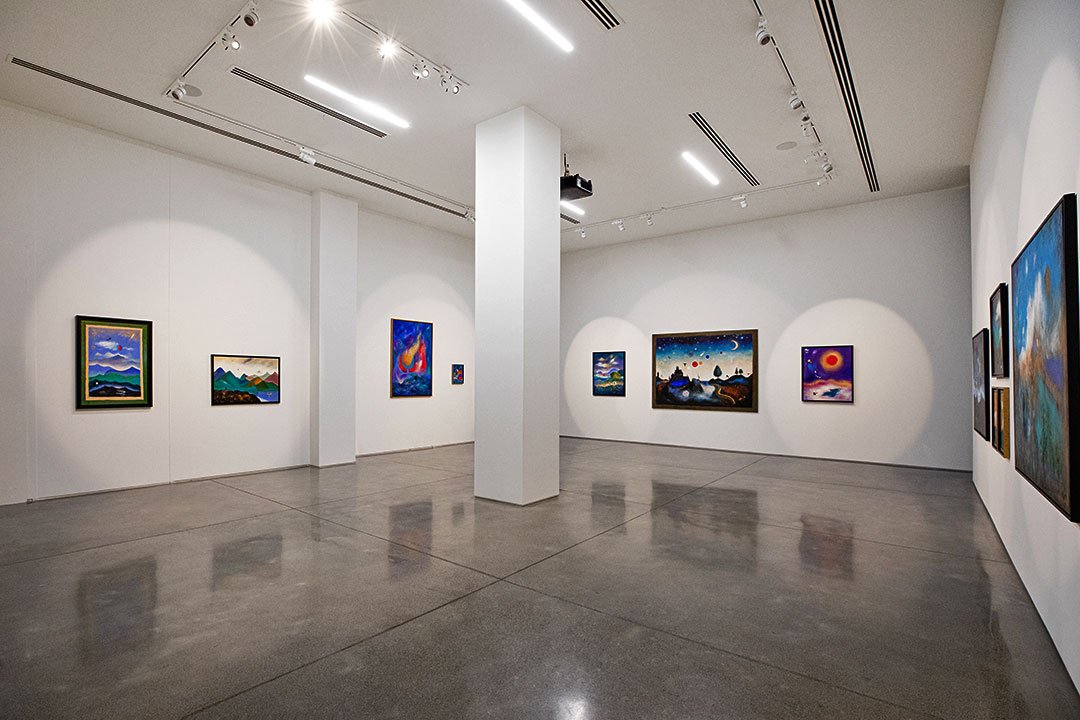
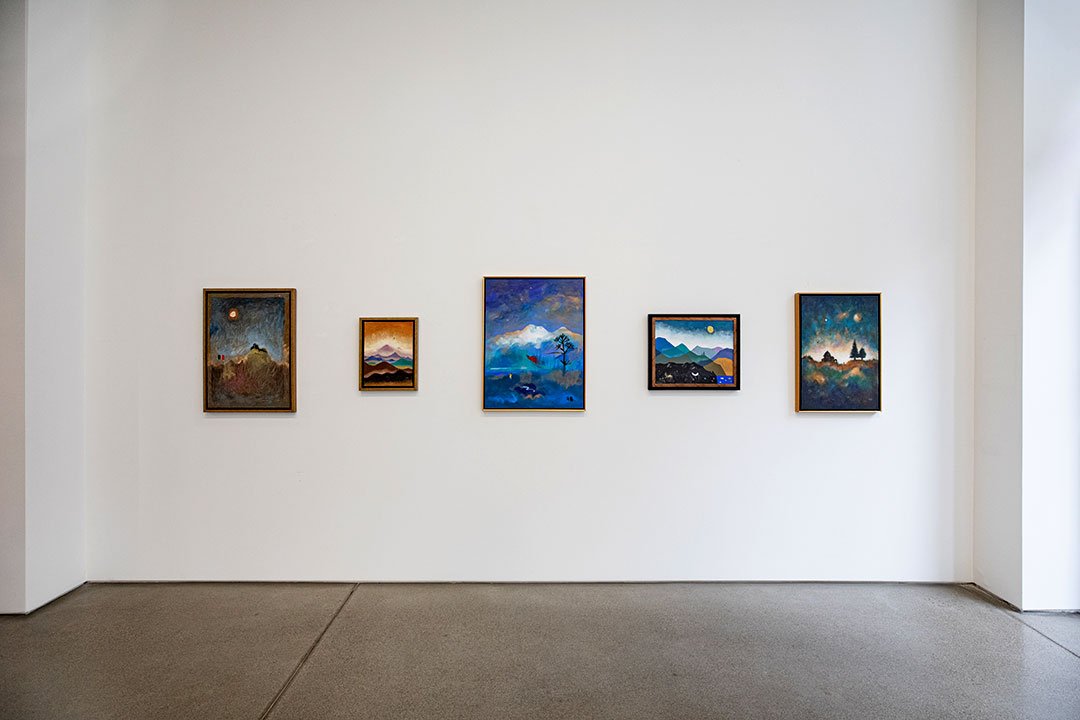
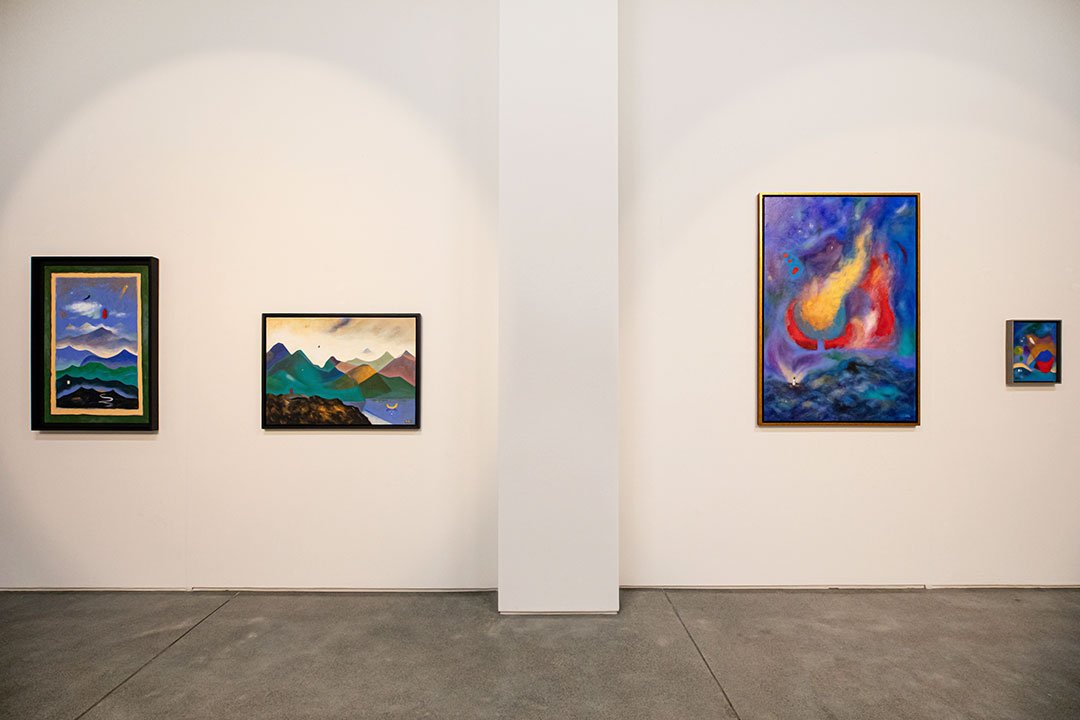
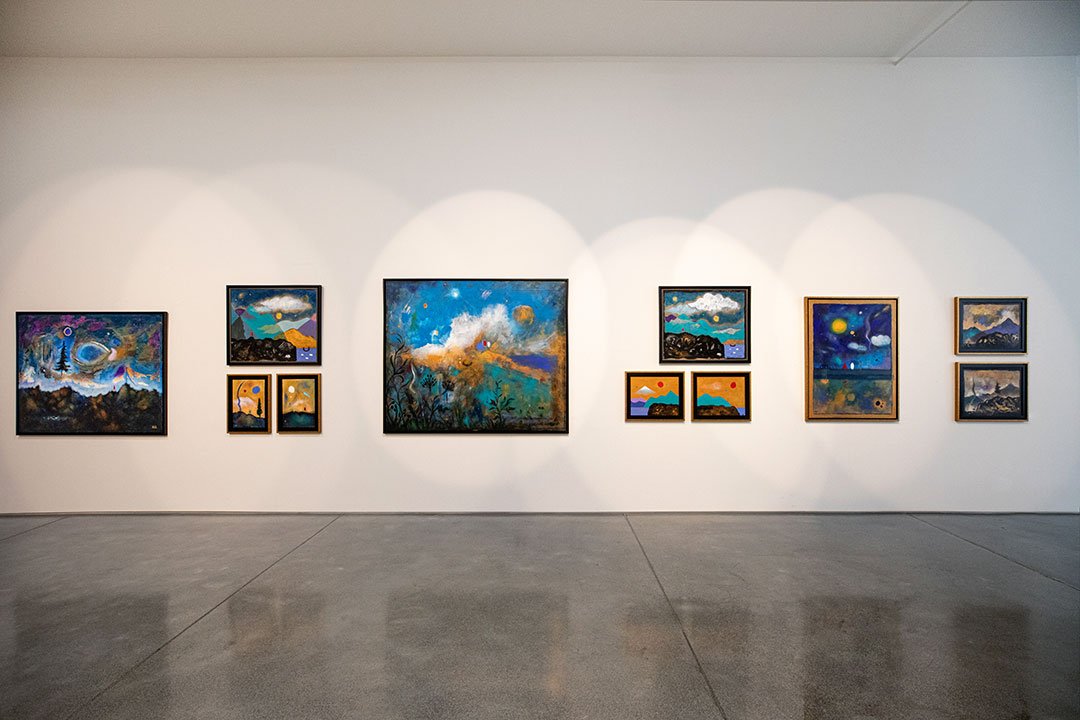
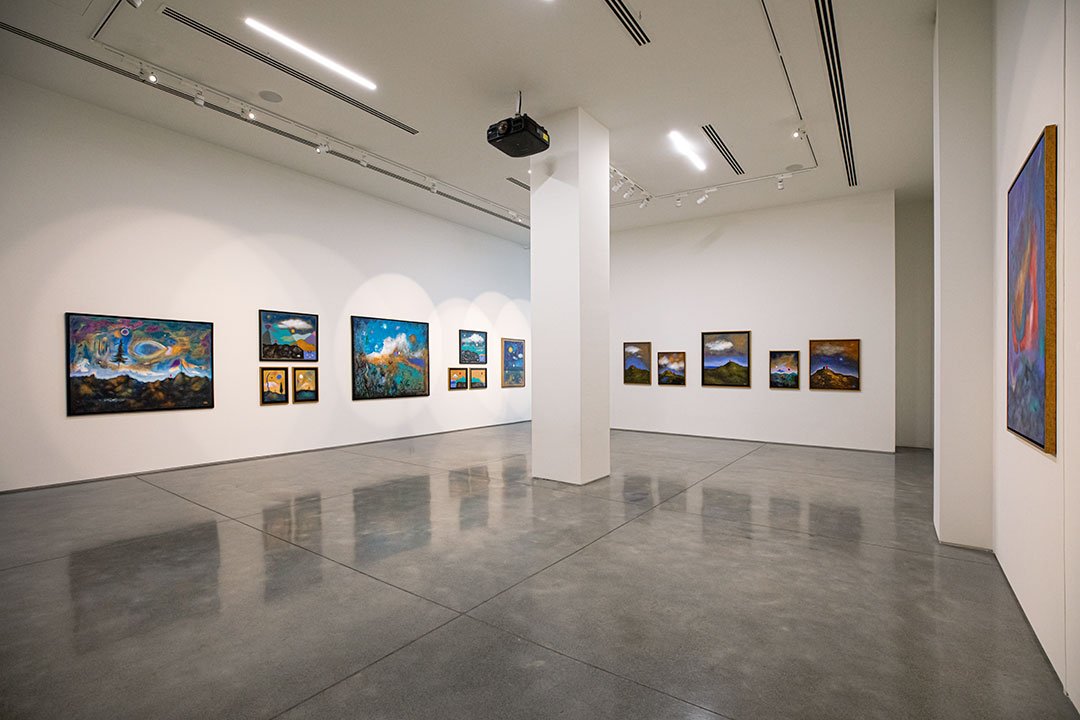
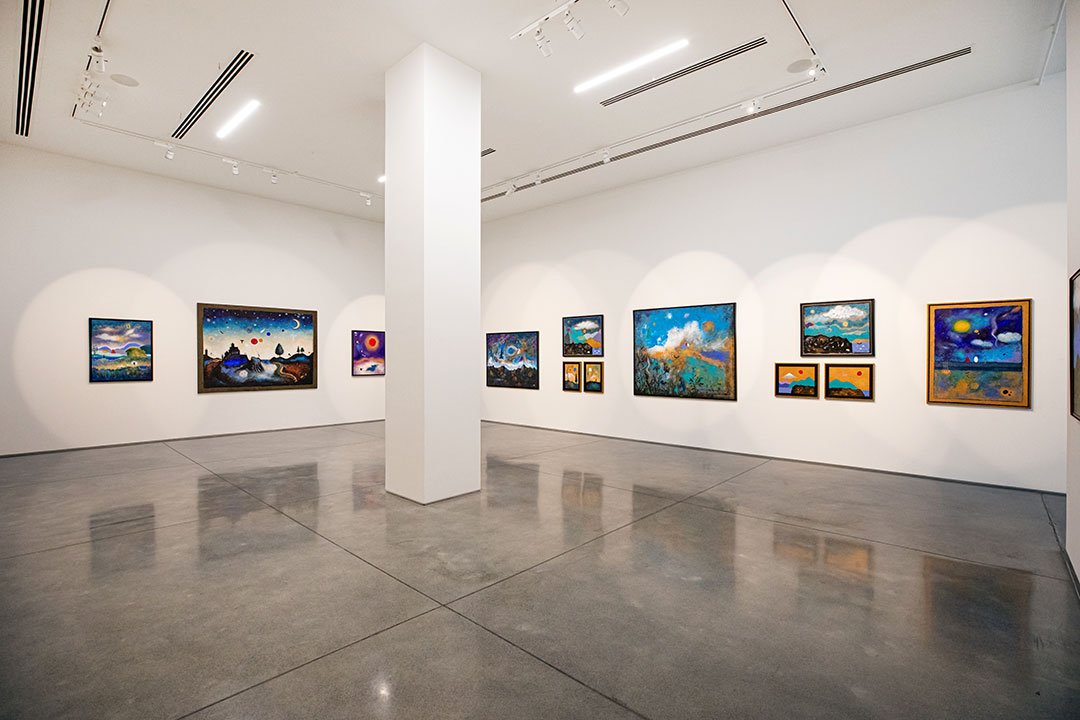
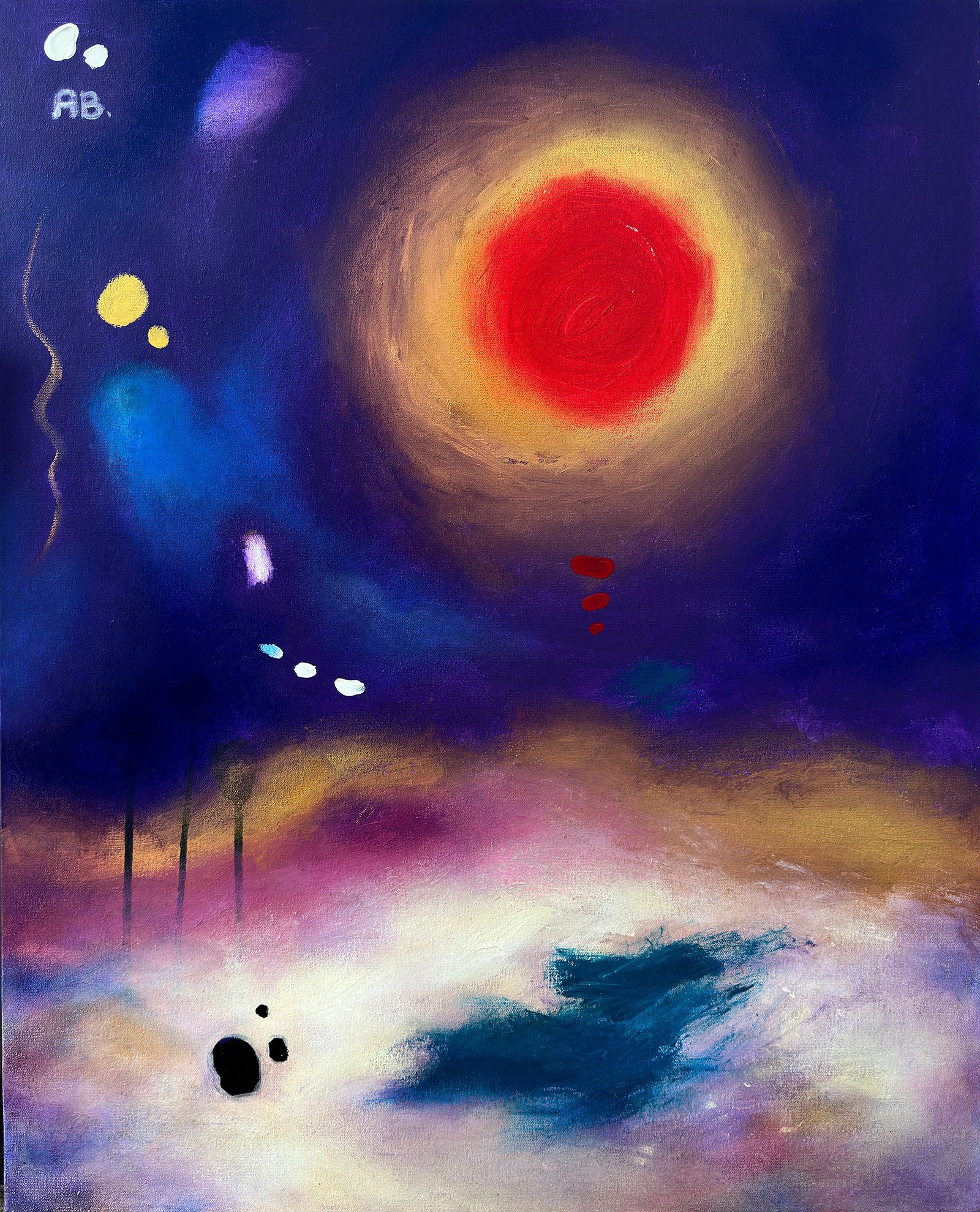
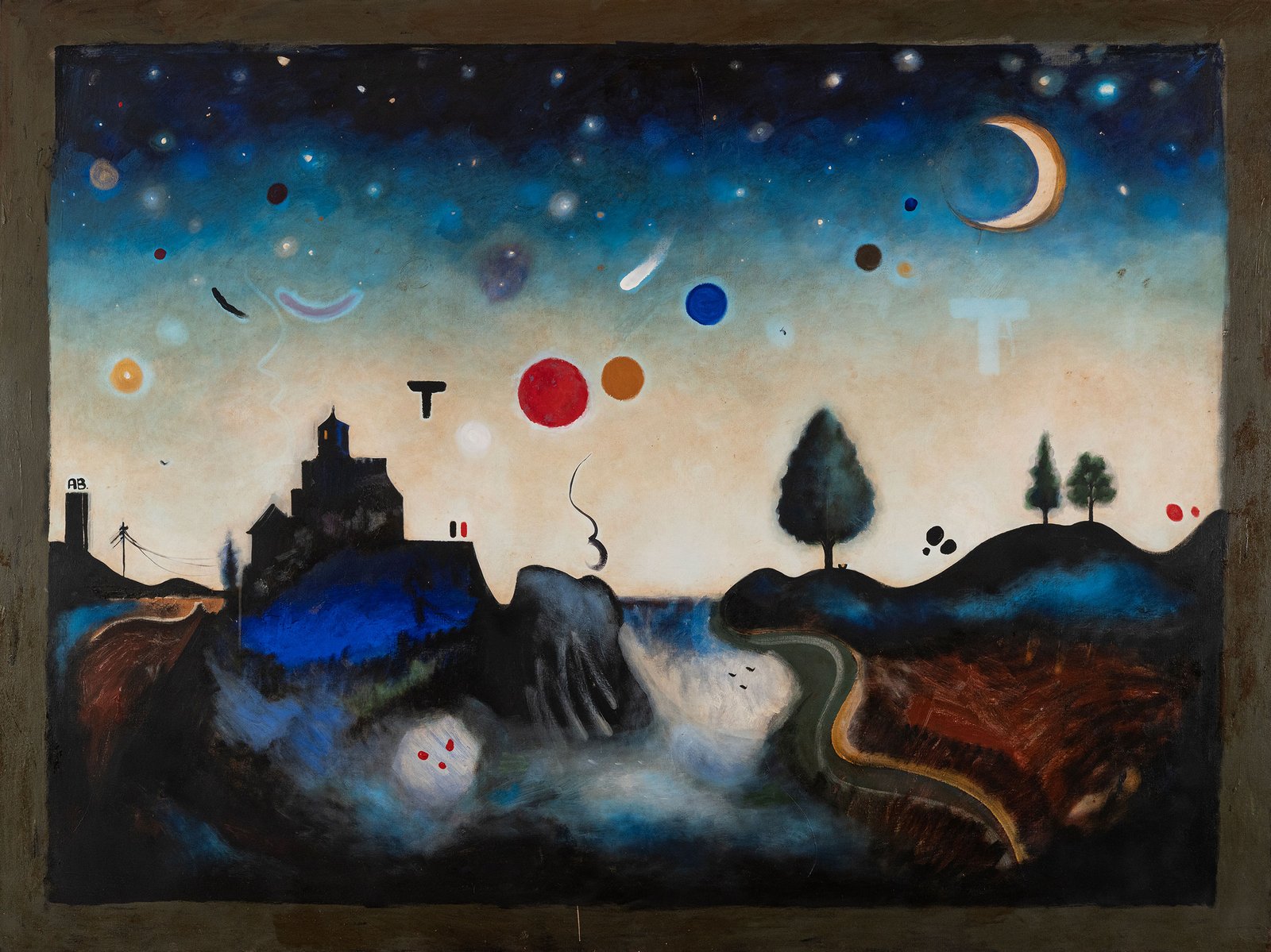
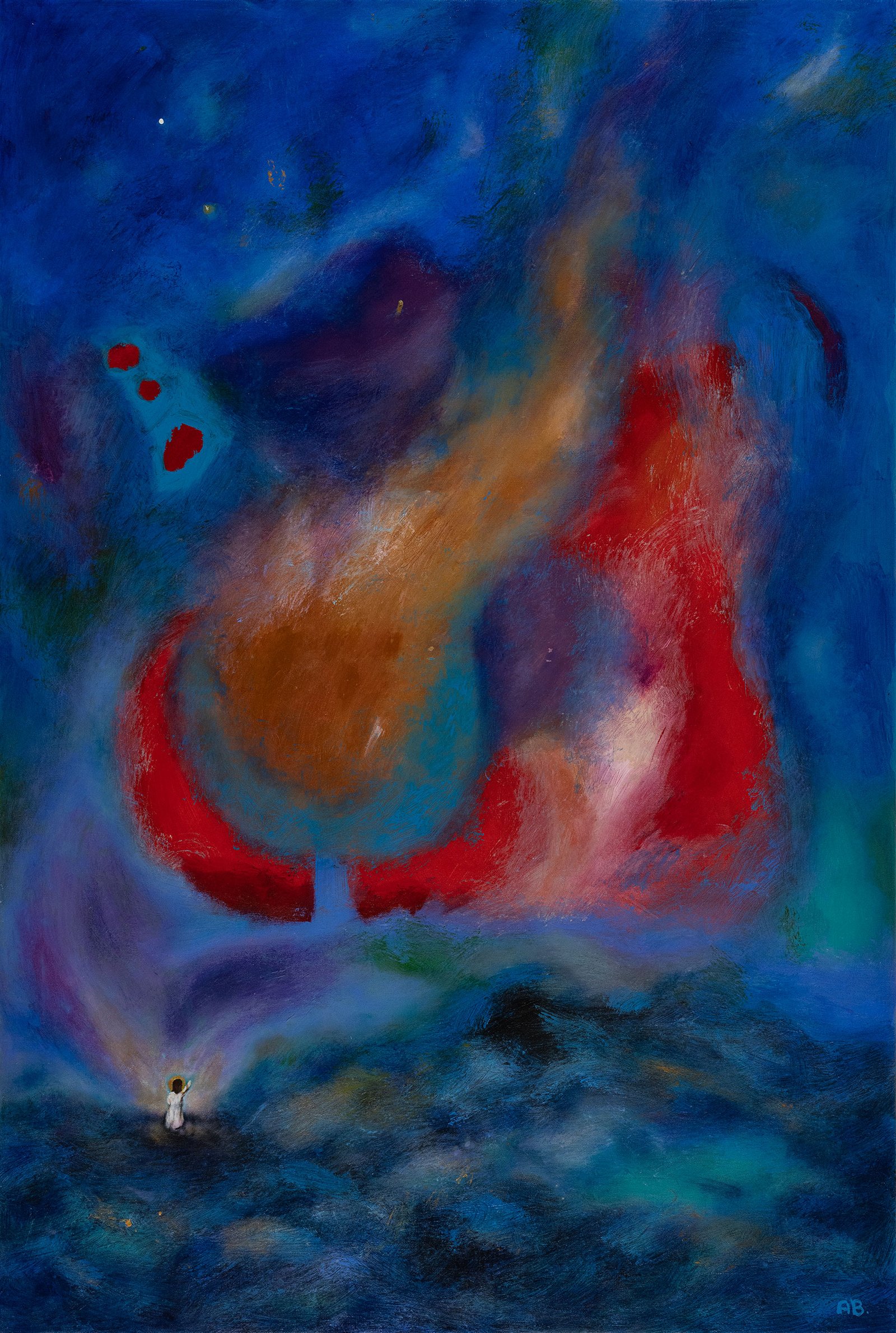
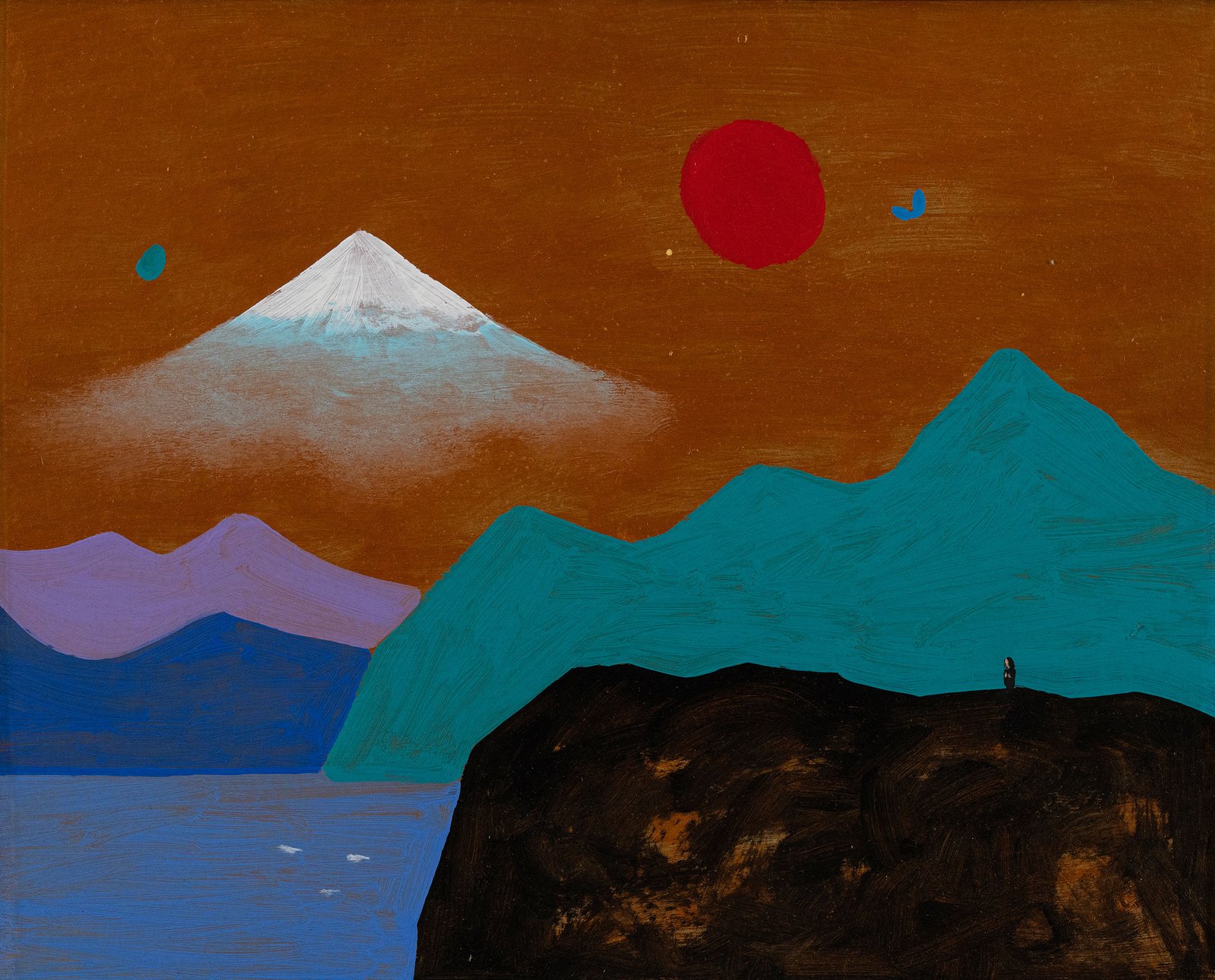
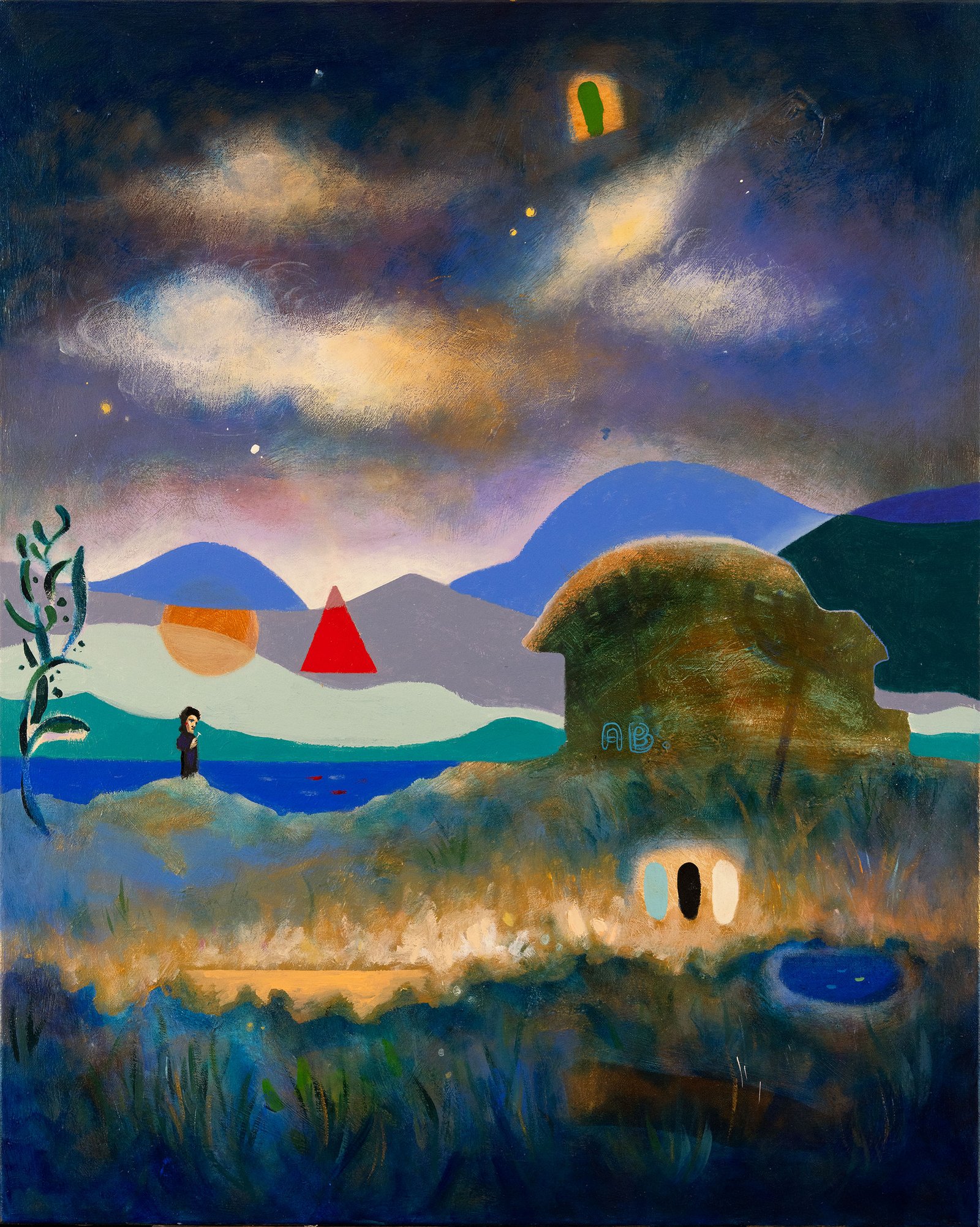
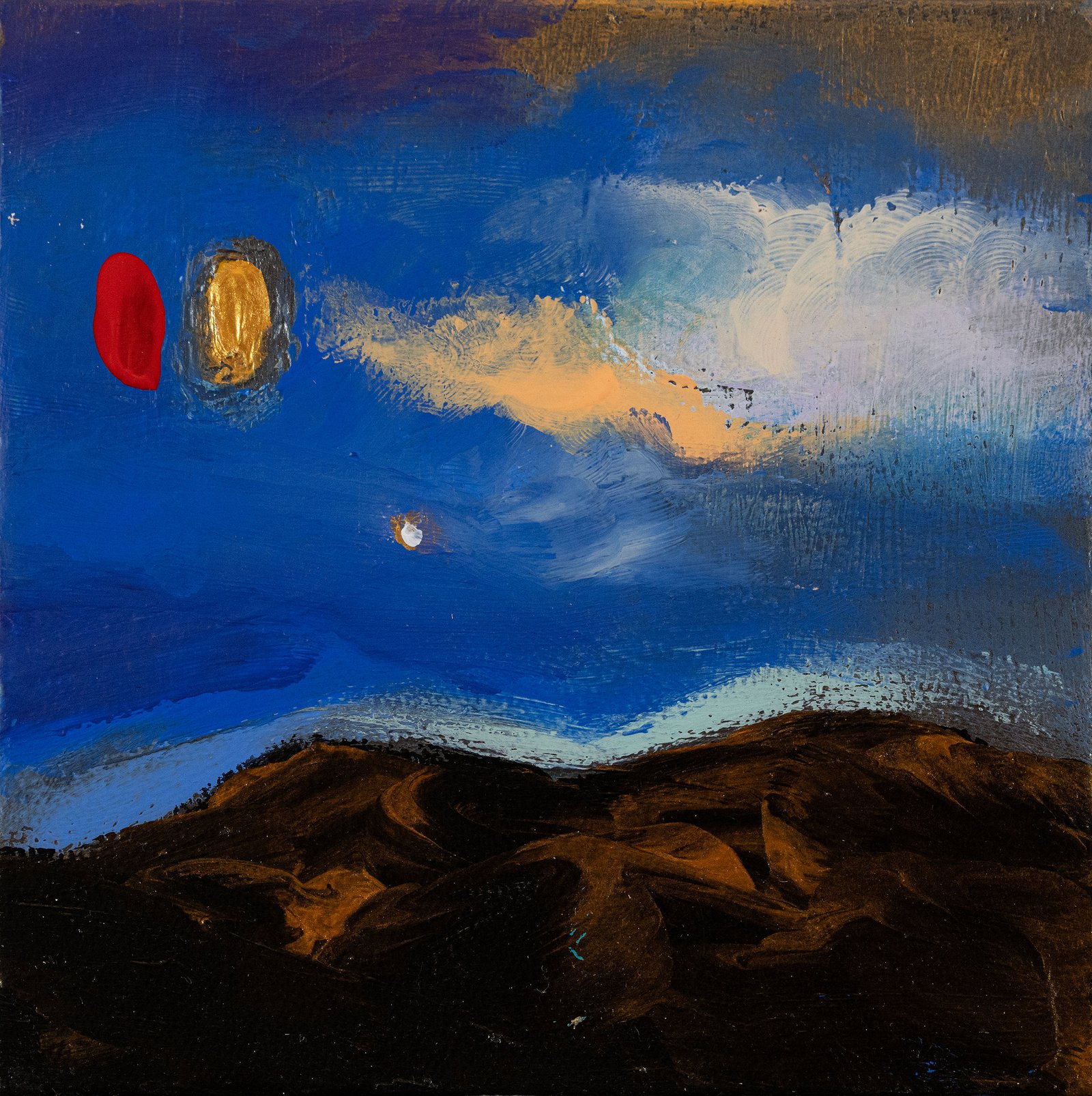
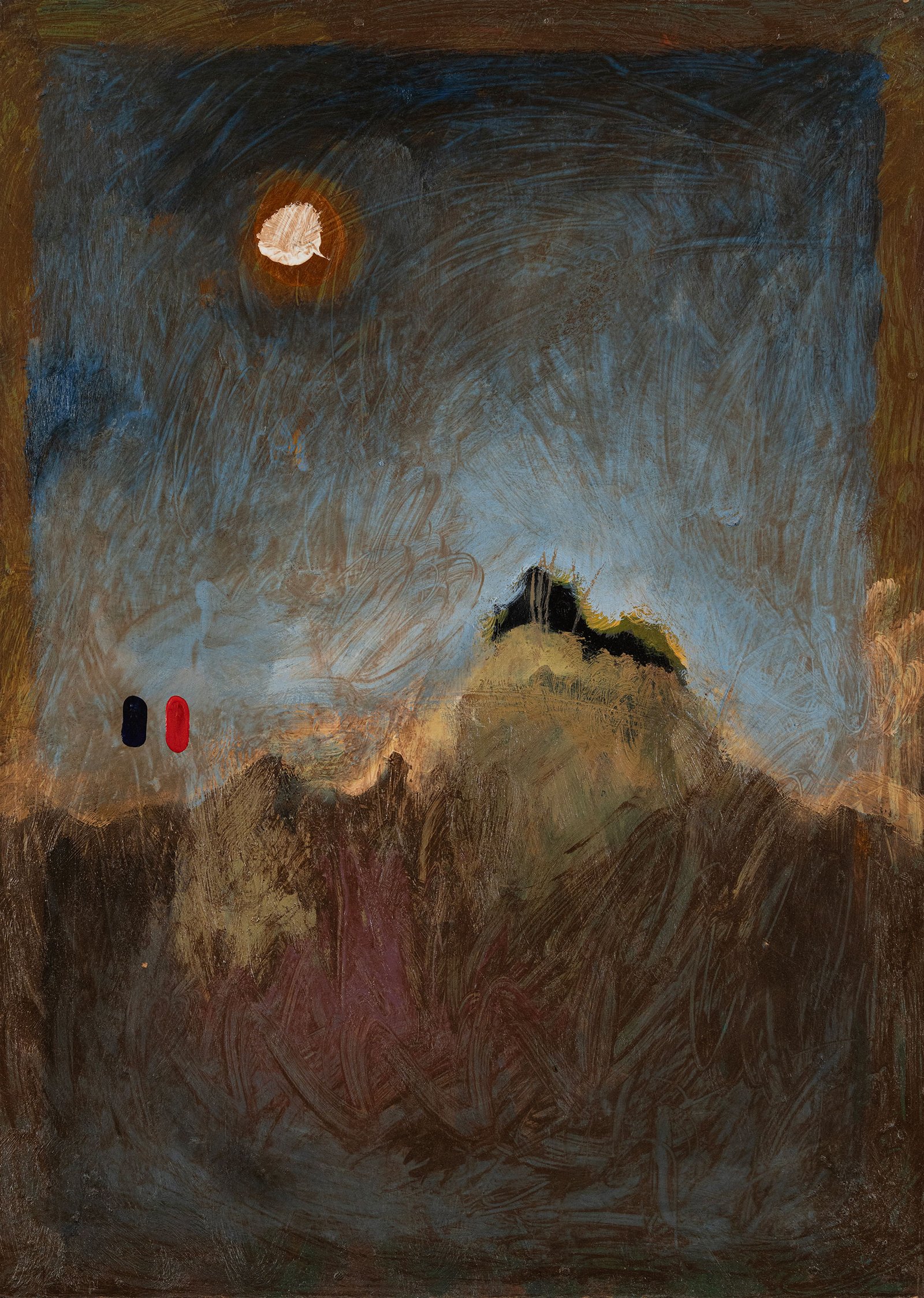
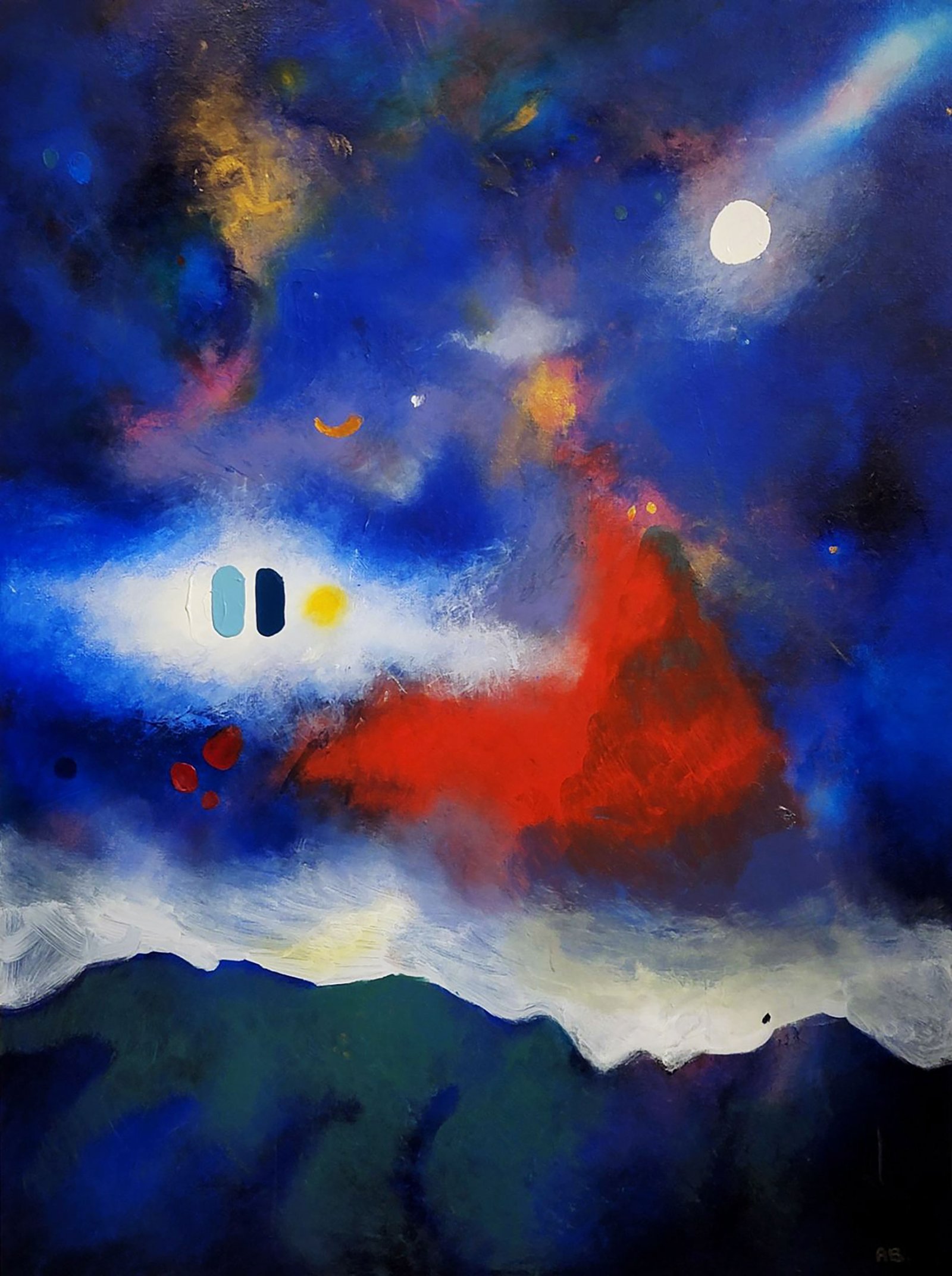
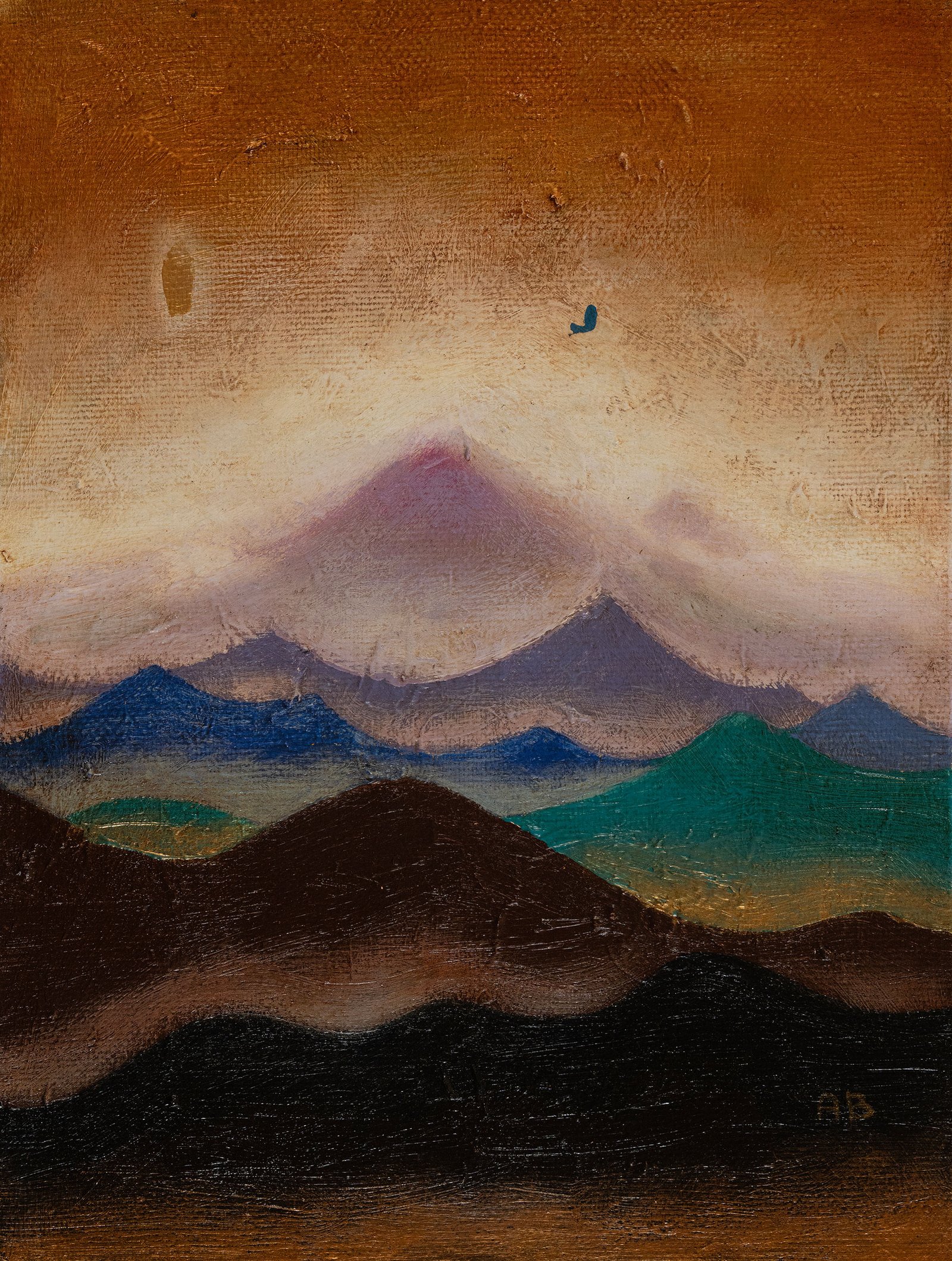
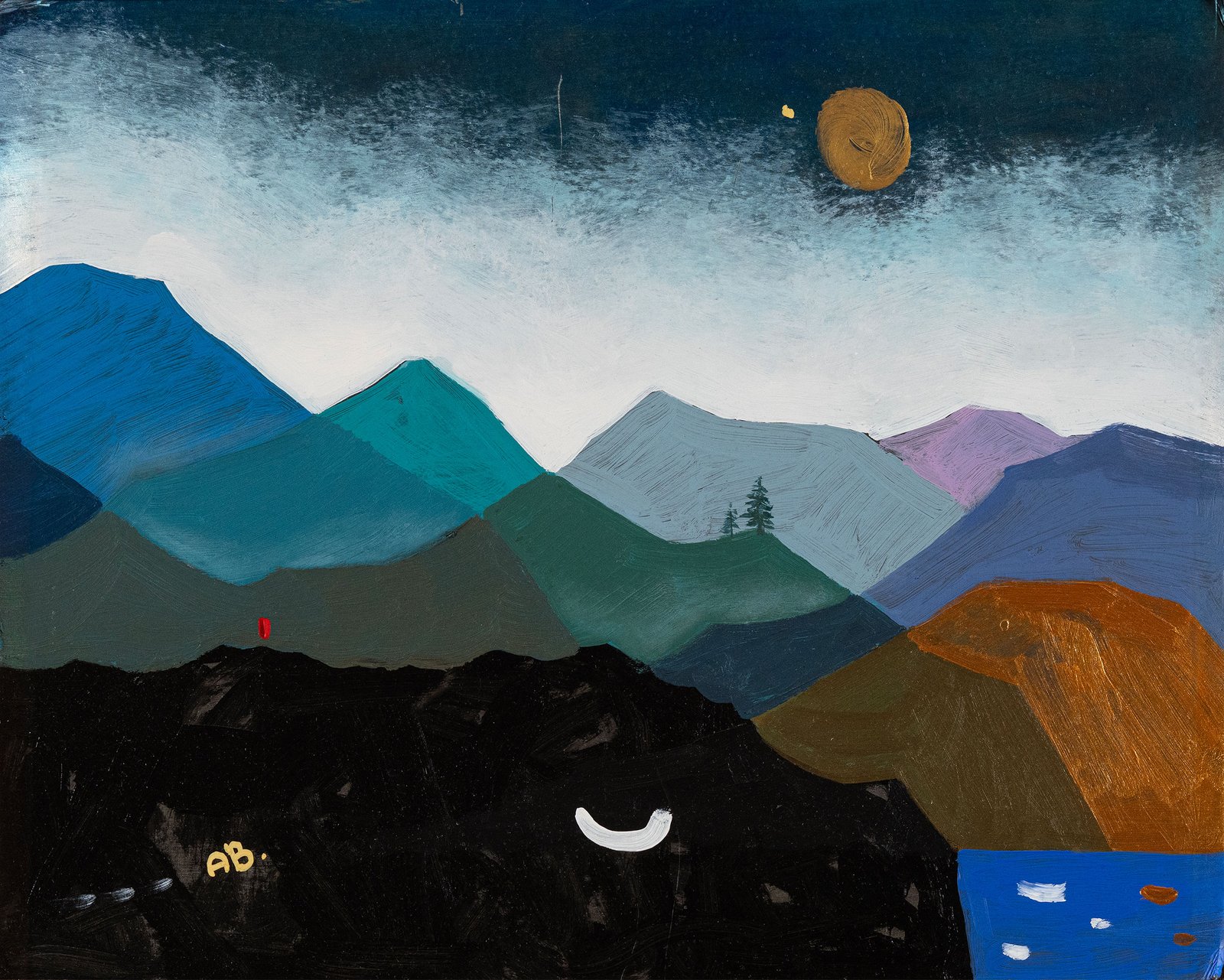

An ultramarine space featuring a red disc. Nearby, we see a second sun, of the same or a different color. Or perhaps more: suns, moons, planets, comets… Their multitude and simultaneity against the turquoise sky resemble a sequence of musical notes. These celestial forms are both essential features of the artist’s imaginary world and necessary pictorial accents integrated into the compositional structure. The image also contains Latin or Georgian letters.
In the lower corner is the inscription “AB,” Anton Balanchivadze’s signature. One is inevitably reminded of Albrecht Dürer’s monogram “AD,” which also serves as an abbreviation for Anno Domini, or the New Era. One is likewise reminded of Irakli Sutidze’s “He,” which often asserts his authorship through a third-person pronoun. A similar duality of meaning can be discerned in Anton Balanchivadze’s initials. Although Anton places a period after them, this does little to interrupt the association: the sequence of letters compels the mind to continue through the alphabet, inviting us to perceive the painting as a cosmogonic text.
This “text” begins with an A, symbolizing the creation of the universe, and concludes with the rhythmic lines of electrical transmission cables stretched across the modern power pylon. The artist seems to suggest that the creation of the universe did not end with the biblical Genesis. It continues to evolve to this day.
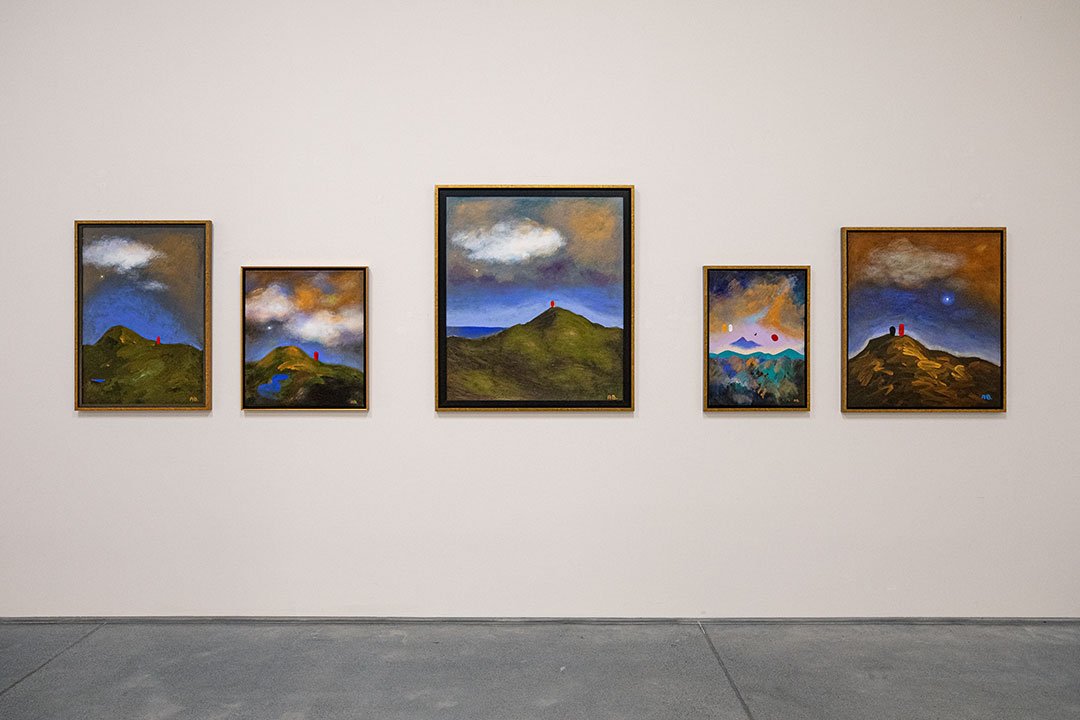
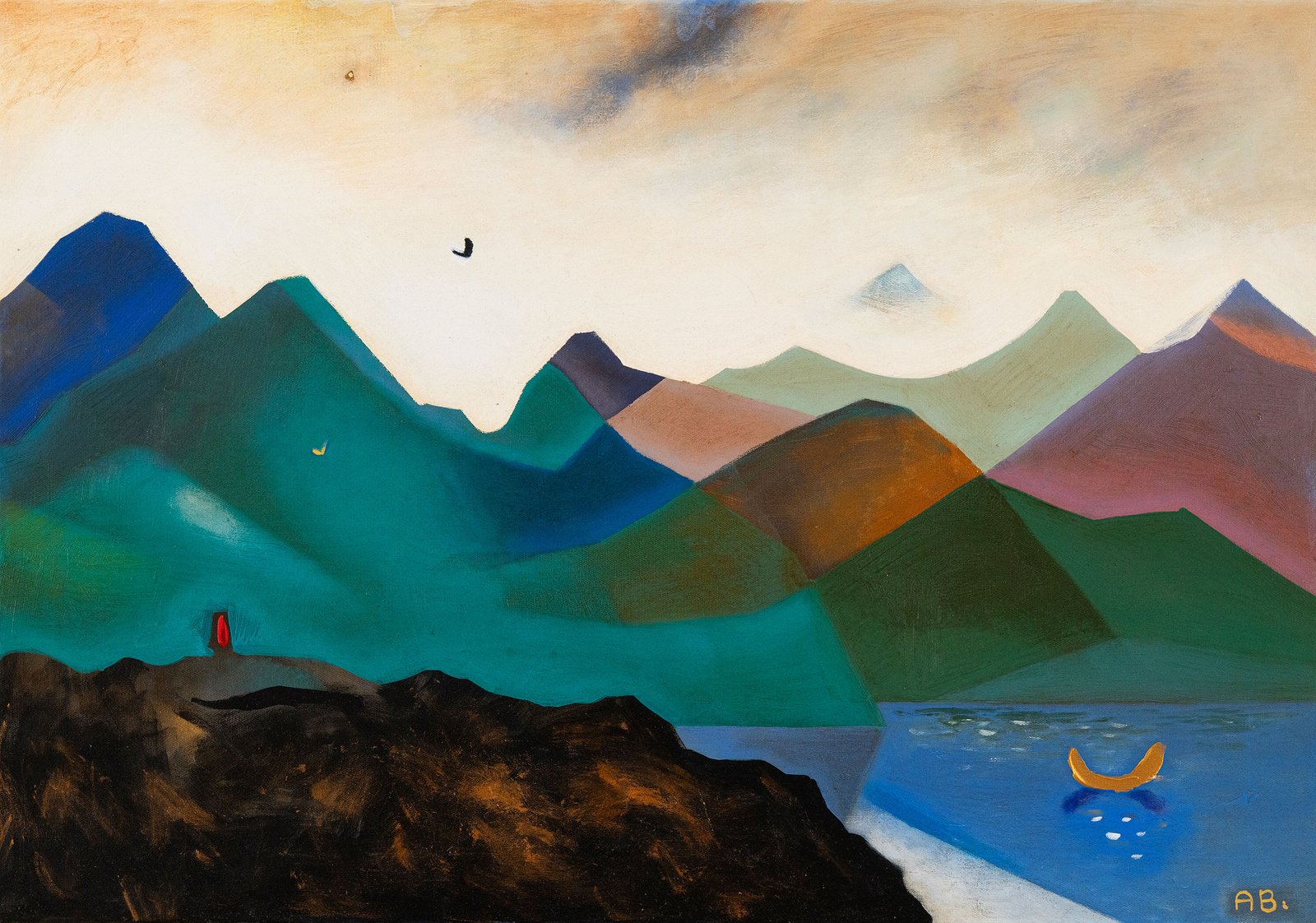
Somewhere in the distance, one might even glimpse a human silhouette. Here, its presence is even more essential than that of the viewer standing before the canvas. After all, how could the viewer be deprived of witnessing the process of transformation within such a magnificent landscape, one that is not a geographical location, but a transcendental space?
Someone will come, look, and leave. Then the lights will be turned off and the hall locked. At that moment, only that silhouette remains on the empty canvas, left to savor the movement of the suns across the azure space. Or perhaps this figure is not merely a contemplator, but the very creator whose word and will transform the view itself.
As W. Kandinsky wrote in Concerning the Spiritual in Art: “Sometimes, it is a single person who stands alone upon the pinnacle of the highest summit. His blissful vision resembles an immeasurable inner anguish…” Perhaps that is why the silhouette in Anton’s work is often rendered in vibrant red. At times, it stands in solitary isolation, like a hermit; at others, a blue or black figure appears beside it, suggesting a kindred spirit with whom this sense of excitement can be shared.
Contemplation is not the only reason for the presence of people in this space. As noted above, the silhouette is also placed there out of compositional necessity to serve as a colored spot or an accent to fulfill a purely
painterly objective. Consequently, the image remains an untouched metaphysical realm of painting, stripped of material substance.
For the artist, the colored spot is a powerful means of exerting a spiritual influence on the viewer. It acts like a sound of such intensity and duration that it strikes the strings of the soul, resonates in a harmonious chord with other colors, and awakens tender feelings.
The musicality of Anton’s painting must surely be part of the legacy of the Balanchivadze dynasty, although the family’s influence extends beyond music. Anton’s father, musician and painter Jarji Balanchivadze, once said that art enters a person’s life in order to transform them. He explored the moral experience of color impulses and new ways of perceiving color. For him, color was not merely a physical or optical phenomenon, but an active spiritual force capable of transforming a person’s inner world.
Experiencing color on a moral level has the power to purify a person, awaken ethical feelings and empathy, and evoke catharsis. If someone contemplating a color allows it to penetrate their inner world, the force inherent in that color can act upon them morally and guide them toward goodness, altering their inner state. Like the concept of “color perspective,” the moral perception of color also introduces new principles to the art of painting. The more an artist contemplates these qualities, the more important the moral impact of color becomes.
Anton, too, shares and explores through his painting the belief that art should sculpt and refine the human soul. History has demonstrated the futility of this endeavor, yet it is precisely the attempt itself that, perhaps more than anything, upholds the cause of spirituality in this degenerate world.
According to Karl-Heinz Deneke, in Jarji Balanchivadze’s paintings, “diverse universes coexist simultaneously, influencing and permeating one another. The human figures that are often depicted without faces are so deeply integrated into landscapes where the sense of distance has been abolished that they seem to bear a mark of something profoundly tolerant, forgiving, and even sacred.”
These words apply equally well to Anton’s work, whether one attributes the connection to his father’s influence or to DNA. Jarji Balanchivadze’s personality attracted numerous young artists, and traces of the Maestro’s guidance are particularly visible in the work of his younger friend and like-minded artist, Irakli Parjiani. Anton, for his part, breathed the same air as his father, making it hardly surprising that his artistic credo resonates with the spirituality and sacred mystery of Jarji’s work.
Anton Balanchivadze’s paintings reveal the process of creating an artistic universe rather than presenting it in a finished state. They do not offer a vision of perfect harmony in which nothing can be added or taken away. On the contrary, the artist leaves room for movement, and allows the compositional elements to move freely; to reach toward one another, or to drift apart. The composition seems to change before the viewer’s eyes. The vibration of color spots invites us to follow this movement and observe the images’ impulse to shift, rearrange themselves, and to create new compositions. The accents move and rhyme with one another like musical notes.
The multitude of colorful spots suggests that none holds primacy, that none represents the center of the universe: not the elongated vertical human silhouette, the circular disk of the sun, the crescent of the moon, the triangle of a mountain, or even a pine tree. These self-sufficient forms drift gracefully on their own, yet together they sound as a harmonious chord in which each note retains its distinct identity.
In the field of painting, which for centuries was closely bound to the depiction or imitation of the material world, Romanticism, Symbolism, and Modernism reintroduced the medieval convention and abstract modes of thought, replacing the rendering of external, or exoteric, forms with a search for inner, esoteric meaning. The processes unfolding in the universe are simultaneously reflected in the depths of Anton Balanchivadze’s soul and translated into the language of painting. The object remains, yet it is enriched with symbolism and is awarded an immaterial significance. In painting, the artist discovers questions that music can address directly through its immaterial language. He translates emotion according to musical principles, expanding color through tonal modulation and giving it the ability to move. That is precisely why Anton’s world is so poetic and sublime.
Anton experiments with materials and techniques, coating the surface of the canvas with a thin, translucent layer of acrylic applied almost like watercolor. Acrylic is a smooth, opaque material, yet a watercolor-like technique lends it a sense of lightness. The artist’s quest is particularly evident in works where the desire to break away from weary academic conventions, linear and aerial perspectives, leads him to abandon the imitation of three-dimensional space.
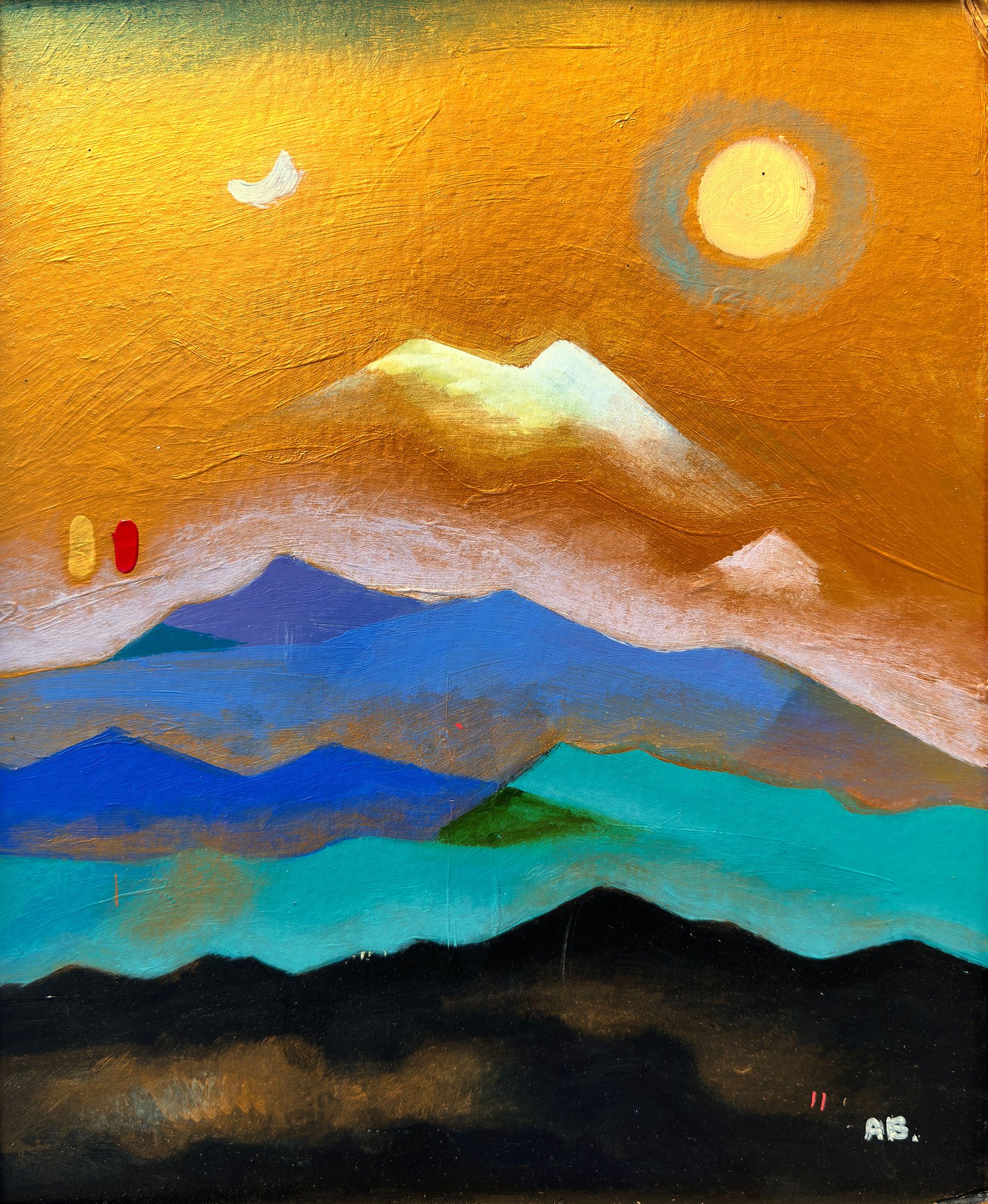
In recent works, alongside the artist’s use of tonal and chromatic transitions and textured surfaces, areas of flat, solid color are enriched by localized textures. Stand motionless before the canvas and contemplate it from a particular angle, and a mountain rendered as a flat plane in a single tone of acrylic rises before you like a solid, static screen, as though nothing exists beyond it. Yet a slight shift to the side transforms the entire impression: the mountain, which moments earlier appeared opaque and motionless, suddenly acquires depth and begins to breathe, revealing a golden hue from the layer beneath.
The image responds to the light and changes with the viewer’s movement, suddenly illuminating everything around it with a kind of divine radiance. In this moment, you become a witness to a “transfiguration,” as the boundary between the physical and metaphysical universes dissolves.
And if you are a sufficiently sensitive “conduit,” perhaps after encountering Anton Balanchivadze’s canvases, you will find it harder to make immoral choices in life.
This effect is driven both by the naive sincerity of Anton’s individual pictorial motifs and by their collective presence as a system, a set of pictograms. Alongside simplified signs representing a planet, mountain, house, or tree, viewers often encounter the recurring Latin letter T or the Georgian letters P and H. These multi-layered symbols play a pivotal role in decoding the artist’s visual world.
The Latin T, or T-shaped cross, known as the Crux Commissa (abutting cross) or Tau cross, can be regarded as another “monogram” of Anton Balanchivadze. A scepter of this shape was an attribute of Saint Anthony, the Egyptian desert father, and came to symbolize victory over evil forces and disease. In the Middle Ages, members of the Order of Saint Anthony wore a sapphire-blue Tau cross on their monastic robes. Saint Francis of Assisi, meanwhile, adopted the sign as his personal signature and as the emblem of the Franciscan Order, where it came to embody humility, penance, and blessing.
The Old Testament prophet Ezekiel recounts how the repentant were spared from God’s wrath by a cross-shaped inked mark of the Tau placed on their foreheads. And this is not the earliest mention of the symbol. Even before the emergence of Christianity, the T-shape was associated with the ancient Egyptian Ankh, the “Key of Life,” understood as a symbol connecting heaven and earth.
Viewed through the lens of geometric symbolism, an aspect that is undoubtedly present in Anton’s paintings through his use of circles and triangles, the Tau cross takes on another layer of meaning. Its vertical line signifies the soul’s aspiration toward the divine, while the horizontal line represents the earthly world and human existence. Their intersection at the highest point symbolically demonstrates the union of earth and heaven, while also suggesting support and protection.
Another favorite motif in Anton Balanchivadze’s iconography is the serpentine line. At times, it reads as the letter P or H; at others, it resembles a riverbank, a bird with outstretched wings, a snake, a lightning bolt, a wave, or a drawn bow. Each of these forms carries a multitude of possible meanings: the energy of water, earth, and air; mysterious and hidden wisdom; quests, spiritual ascent, and transformation.
Whatever its specific interpretation, this recurring element infuses the painting with multiple layers of meaning, while introducing a sense of dynamism and energy into the structure of the composition.
Anton Balanchivadze’s “hieroglyphs,” symbols, and signs, form parts of a unified sacred system. He repeats them to show us that their true home lies here, within this transcendent landscape. Their presence transforms the painting into a consoling prayer. The attempt to decipher the vocabulary of this prayer stirs the viewer’s thoughts and emotions, setting the soul in motion alongside the signs themselves.
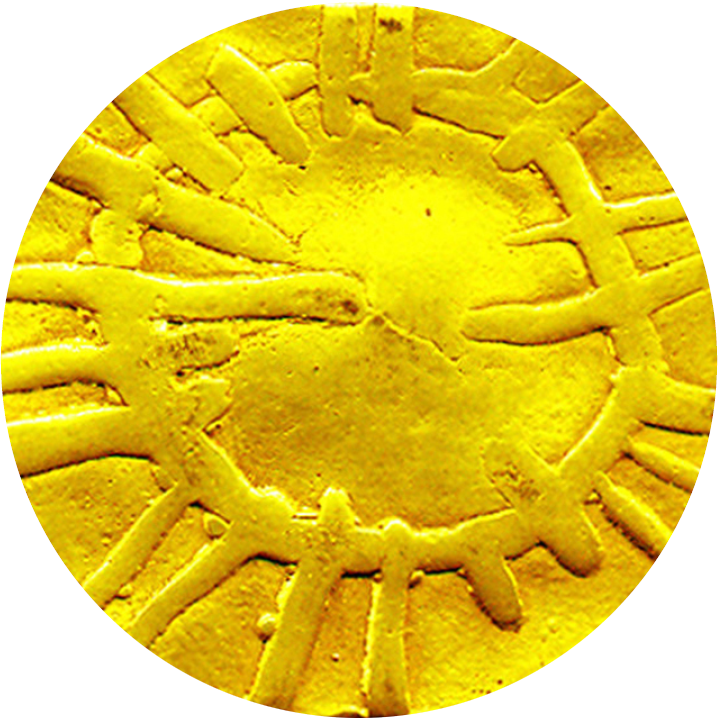
The sacred nature of Anton Balanchivadze’s painting is also underscored by the preciousness of his two favourite pigments: azure and gold, which are, after all, the primordial colors of the universe. Following the separation of light and darkness, God introduced color into creation, where the sun, earth, sky, and water embody the very harmony of blue and gold.
The syntax, or compositional structure, morphemes, or imagery, and phonetics, expressed through the deep, intense coloration of sound, of Anton Balanchivadze’s “prayer,” unintentionally echo the artistic visions of Odilon Redon, Marc Chagall, Jarji Balanchivadze, and Irakli Parjiani. However, his latest work transcends the grammar of painting itself. Anton Balanchivadze creates a sculpture.
The lotus flower embodies his artistic and spiritual beliefs, symbolizing awakening, purity, rebirth, and harmony. Rising from murky waters, its petals remain pure and pristine, untouched by either water or mud. In a complex and troubled world, Anton’s work similarly speaks of preserving inner purity, spiritual tranquility, and moral strength.
This symbolism has deep roots in Buddhist iconography, where the Buddha is often depicted seated on a lotus flower, signifying complete spiritual purification. Through this image, Anton Balanchivadze reminds us that even in the harshest of environments, purity and harmony can emerge.
Sophiko Keburia